TL;DR
- A GPU-ready datacenter is purpose-built for high-density GPU clusters, not retrofitted from traditional setups
- AI workloads demand extreme power, advanced cooling, and ultra-low latency networking working in sync
- Without GPU-first architecture, training slows, costs rise, and scalability breaks
- The real advantage lies in integrated infrastructure design, not just adding GPUs
AI is pushing infrastructure to its limits.
Training large models, running inference at scale, and deploying real-time AI applications are not just compute problems anymore. They are infrastructure problems.
Most traditional datacenters were never designed for this shift. They were built for predictable workloads, moderate compute density, and standard networking. AI changes all of that.
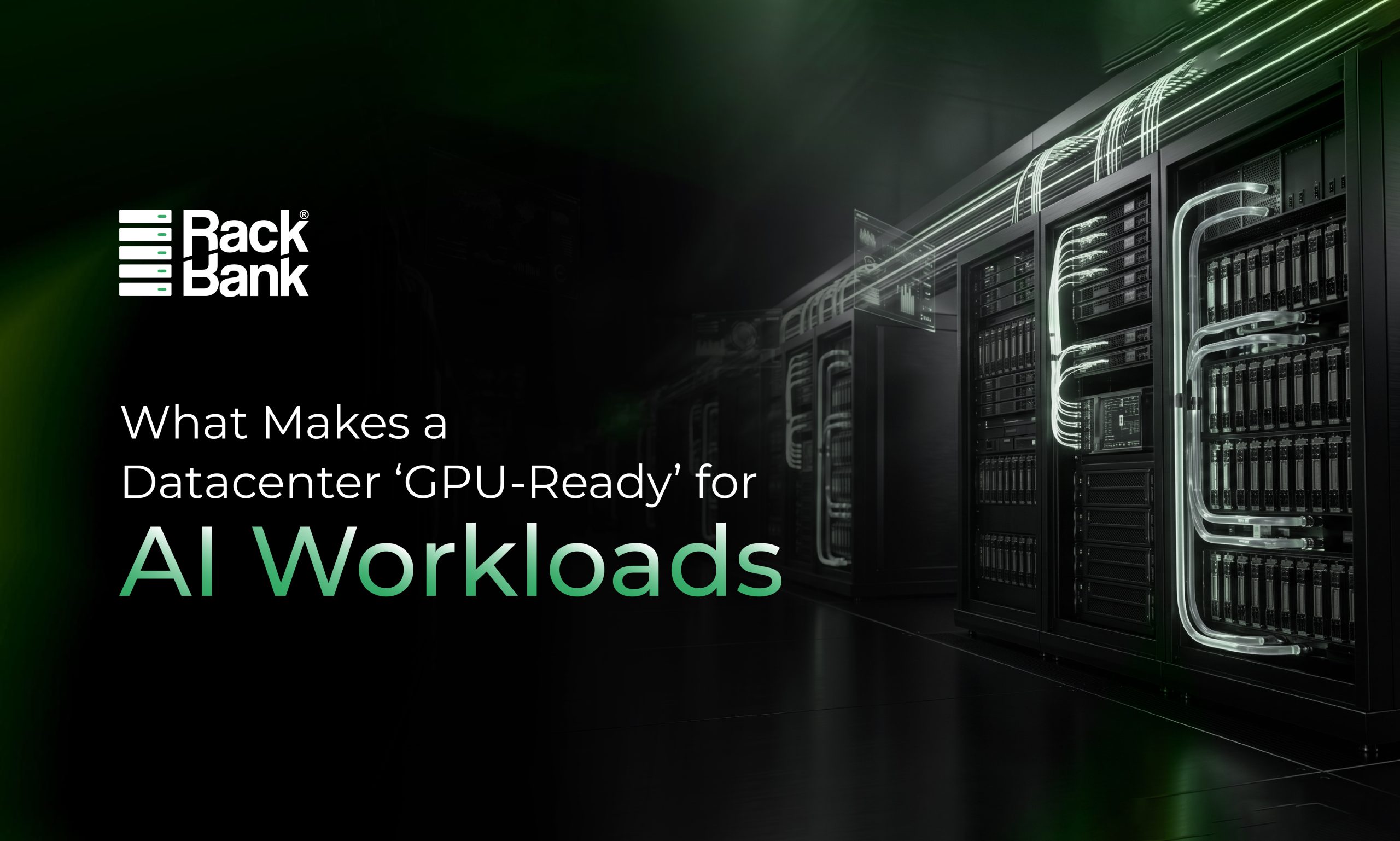
A GPU-ready datacenter is not simply a facility with GPUs installed. It is a completely re-engineered environment designed to handle high-performance AI infrastructure requirements from the ground up.
Why Traditional Datacenters Fail for AI Workloads
Before understanding what works, it is important to see what breaks.
| Limitation | Traditional Datacenter | AI Workloads Reality |
|---|---|---|
| Compute Density | Low to moderate | Extremely high GPU density |
| Cooling | Air cooling | Advanced liquid cooling for GPUs |
| Networking | Standard Ethernet | InfiniBand networking for AI |
| Power | Static provisioning | Dynamic, high power bursts |
| Scalability | Linear scaling | Parallel, distributed scaling |
AI workloads are parallel by nature. Training an LLM or running multi-GPU architecture requires synchronized compute across clusters.
A traditional setup leads to bottlenecks like:
- GPU underutilization
- High latency between nodes
- Thermal throttling
- Power instability
This is why simply colocating GPU servers for AI inside a legacy facility rarely works.
Core Components of a GPU-Ready Datacenter
1. High-Density GPU Infrastructure
AI workloads require dense GPU clusters packed into racks.
Modern GPU infrastructure for AI often exceeds 30–80 kW per rack, compared to 5–10 kW in legacy environments.
This density enables:
- Faster model training
- Efficient multi-GPU communication
- Reduced physical footprint
Without proper design, this density becomes a liability instead of an advantage.
2. Advanced Cooling Systems
Cooling is not an afterthought in an AI-ready datacenter. It is a foundational layer.
Air cooling struggles beyond certain thermal thresholds. This is where liquid cooling for GPUs becomes critical.
| Cooling Type | Use Case | Efficiency |
|---|---|---|
| Air Cooling | Low-density workloads | Limited |
| Rear-door heat exchangers | Medium density | Moderate |
| Direct-to-chip liquid cooling | High-density GPU clusters | High |
| Immersion cooling | Extreme AI environments | Very high |
Efficient cooling ensures:
- Stable GPU performance
- No thermal throttling
- Longer hardware lifespan
3. High-Speed, Low-Latency Networking
AI training depends heavily on how fast GPUs communicate with each other.
Technologies like InfiniBand networking for AI and NVLink infrastructure enable ultra-fast data transfer between nodes.
In an AI GPU cluster, networking determines:
- Training time
- Model convergence speed
- Cluster efficiency
Even the most powerful GPUs fail to deliver results if network latency is high.
4. Scalable Power Architecture
AI workloads are power-intensive and unpredictable.
A datacenter for AI workloads must support:
- High power density per rack
- Redundant power systems
- Rapid scaling without downtime
| Parameter | Requirement for AI |
|---|---|
| Rack Power | 30 kW to 80 kW+ |
| Redundancy | N+1 or higher |
| Efficiency | Optimized PUE |
| Scalability | Modular expansion |
Power is not just about supply. It is about stability under peak load conditions.
5. GPU Orchestration and Software Layer
Infrastructure alone is not enough.
Efficient GPU orchestration ensures that resources are utilized optimally across workloads.
This includes:
- Container orchestration for AI workloads
- Multi-GPU scheduling
- Workload isolation
- Dynamic scaling
Without orchestration, even the best accelerated computing infrastructure leads to wasted resources.
6. AI-Optimized Storage and Data Pipeline
AI models consume massive datasets.
A high-performance AI infrastructure integrates storage that supports:
- High throughput
- Parallel data access
- Low latency pipelines
This directly impacts:
- Training speed
- Data preprocessing
- Real-time inference
What Hyperscalers Already Know
Global hyperscalers have already moved to hyperscale GPU datacenter models.
Their approach includes:
- Purpose-built AI zones
- Dedicated AI clusters
- Custom networking fabrics
- Integrated cooling and power systems
This is not incremental improvement. It is a complete architectural shift toward AI compute infrastructure.
Key Metrics That Define a GPU-Ready Datacenter
| Metric | Why It Matters |
|---|---|
| GPU Utilization Rate | Indicates efficiency of infrastructure |
| Network Latency | Impacts distributed training |
| Cooling Efficiency | Prevents thermal throttling |
| Power Usage Effectiveness | Controls operational cost |
| Time to Scale | Determines business agility |
These metrics directly influence ROI for AI deployments.
India’s Growing Demand for AI Infrastructure
India is seeing rapid growth in:
- AI startups
- Enterprise AI adoption
- Generative AI workloads
This creates demand for:
- GPU hosting India
- AI cloud infrastructure India
- Enterprise-grade AI inference infrastructure
Organizations are moving from experimentation to production. That shift requires reliable, scalable AI datacenter infrastructure.
Conclusion
A GPU-ready datacenter is no longer optional.
It is the foundation of modern AI systems. Without it, even the best models struggle to scale, perform, or deliver value.
The real shift is this:
Infrastructure is no longer backend support. It is the core enabler of AI innovation.
RackBank is building AI-ready datacenter environments designed specifically for high-density GPU workloads, advanced cooling, scalable power, and ultra-fast networking.
For teams working on LLMs, generative AI, or enterprise-scale deployments, the difference is clear.
The right infrastructure does not just support AI. It accelerates it.
If your AI workloads are hitting infrastructure limits, it is time to upgrade the foundation.
Access GPU-ready infrastructure built for high-density AI training and real-time deployment.
Explore GPU cloud and start scaling your AI workloads with confidence