

TL;DR:
- Private AI runs your models and data inside infrastructure you control, not on shared public clouds, which matters more as DPDP Act enforcement tightens in India.
- The stack is straightforward: dedicated GPUs, isolated networking, private LLM hosting, and India-based data residency.
- BFSI, healthcare, and government workloads are moving fastest because regulators expect data to stay put.
- Costs are predictable versus token-based public APIs once inference volume crosses a threshold, usually somewhere between 30 and 50 million tokens a month.
- RackBank offers dedicated GPU infrastructure out of Indian datacenters for teams that need Private AI without building it themselves.
Introduction: Why Private AI Matters for Indian Enterprises
Ask any Indian enterprise IT head what’s blocking their AI rollout and the answer rarely involves the model itself. It’s almost always about where the data goes when a prompt is sent. The Digital Personal Data Protection Act, RBI’s data localization mandates, and CERT-In’s incident reporting rules have turned this from a philosophical debate into a board-level line item. Private AI is the answer most enterprises are landing on.
What Is Private AI?
Private AI is the practice of training, fine-tuning, and running AI models on infrastructure that your organization exclusively controls. No shared tenancy, no data leaving your perimeter, no third party logging your prompts for model improvement. The compute, storage, networking, and model weights all sit inside a boundary you define, typically a dedicated GPU cluster in an Indian datacenter or your own colocation footprint.
How Private AI Differs from Public AI Platforms
Public AI platforms like ChatGPT or Gemini API are multi-tenant. Your query travels to a shared endpoint, gets processed alongside millions of others, and returns a response. Convenient, but you have limited visibility into where data lands, how long logs are retained, or which jurisdiction governs the servers.
Private AI flips this. You own the model weights or license them, you pick the GPUs, you decide the retention policy. Latency is often better too, because inference happens closer to your users.
Key Components of a Private AI Infrastructure
A working Private AI stack usually has five layers:
Dedicated GPU infrastructure, typically H100, H200, or L40S nodes depending on workload. Isolated networking with private VLANs and no public egress by default. A model serving layer such as vLLM, TGI, or Triton. An orchestration layer for fine-tuning and evaluation. And a governance layer that logs every prompt and response for audit.
Why Indian Enterprises Are Adopting Private AI
Three forces are converging. DPDP Act penalties can hit 250 crore per violation. Cross-border data transfer restrictions are tightening. And the economics of public APIs stop making sense once you’re running production workloads at scale. A mid-sized bank running fraud detection on transaction descriptions can burn through 40 lakh a month in API fees, which pays for a dedicated GPU cluster in under a year.
Benefits of Private AI
Data privacy and security – Prompts and completions never leave your environment. No shared inference logs, no accidental training on your proprietary data.
Compliance and regulatory readiness– DPDP, RBI, IRDAI, and sector-specific rules become straightforward when data residency is provable.
Full control over models and data– You choose the base model, the fine-tuning data, and the update cadence. No forced deprecations mid-quarter.
Improved performance and customization– Fine-tuned smaller models often outperform generic large ones on narrow tasks, at a fraction of the inference cost.
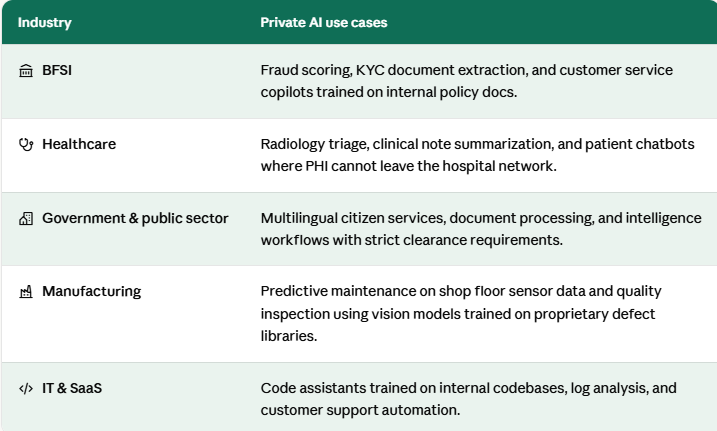
Common Private AI Use Cases
Public AI vs Private AI: A Comparison
| Dimension | Public AI | Private AI |
|---|---|---|
| Data residency | Vendor-controlled, often overseas | Your choice, India-resident |
| Cost model | Per-token, unpredictable at scale | Fixed infrastructure, predictable |
| Model control | Vendor updates, possible deprecation | You control versions |
| Compliance fit | Requires DPA and legal review | Native fit for DPDP, RBI, IRDAI |
| Customization | Limited fine-tuning | Full fine-tuning and RAG control |
| Latency | Depends on vendor region | Sub-50ms achievable in-country |
How RackBank Enables Private AI in India
RackBank runs Tier III datacenters in India with dedicated GPU infrastructure available on rent or purchase. Teams can spin up H100 or L40S nodes for private LLM hosting, fine-tuning, or inference workloads without procurement lead times. Everything stays in India, billing is in rupees, and support is local.
Challenges of Implementing Private AI (and How to Overcome Them)
Talent is the first hurdle. Hiring ML engineers who understand both model serving and infrastructure is hard. Managed GPU providers close this gap.
Capital expenditure worries some CFOs. Renting GPUs monthly instead of buying resolves it.
Model selection is the third challenge. Start with an open-weight model like Llama 3 or Mistral, benchmark against your actual use case, and iterate.
Is Private AI Right for Your Organization?
If you handle regulated data, process more than roughly 30 million tokens a month, or your legal team has raised concerns about public API terms, the answer is probably yes. If you’re prototyping or running low-volume internal tools, public APIs are still fine.
Final Thoughts
Private AI is not about rejecting the cloud or fearing innovation. It’s about matching the deployment model to the sensitivity of the data and the economics of the workload. For most Indian enterprises with regulated data or serious inference volume, the math and the law both point the same direction.
Talk to RackBank about renting or buying GPU capacity for your Private AI workload.
FAQs
What is Private AI for enterprises?
It’s AI infrastructure that runs entirely within an organization’s controlled environment, with no data sharing across tenants or jurisdictions.
How do I deploy Private AI in India?
Rent dedicated GPUs from an Indian provider, deploy an open-weight model using vLLM or similar, and connect it to your application over private networking.
Is Private AI more expensive than public APIs?
Below roughly 30 million tokens a month, public APIs are cheaper. Above that, Private AI usually wins on total cost.
Which industries benefit most from Private AI?
BFSI, healthcare, government, and manufacturing, mainly because of data sensitivity and regulatory obligations.
Can Private AI meet DPDP Act requirements?
Yes, when hosted in Indian datacenters with proper access controls and audit logging, Private AI aligns naturally with DPDP obligations.