

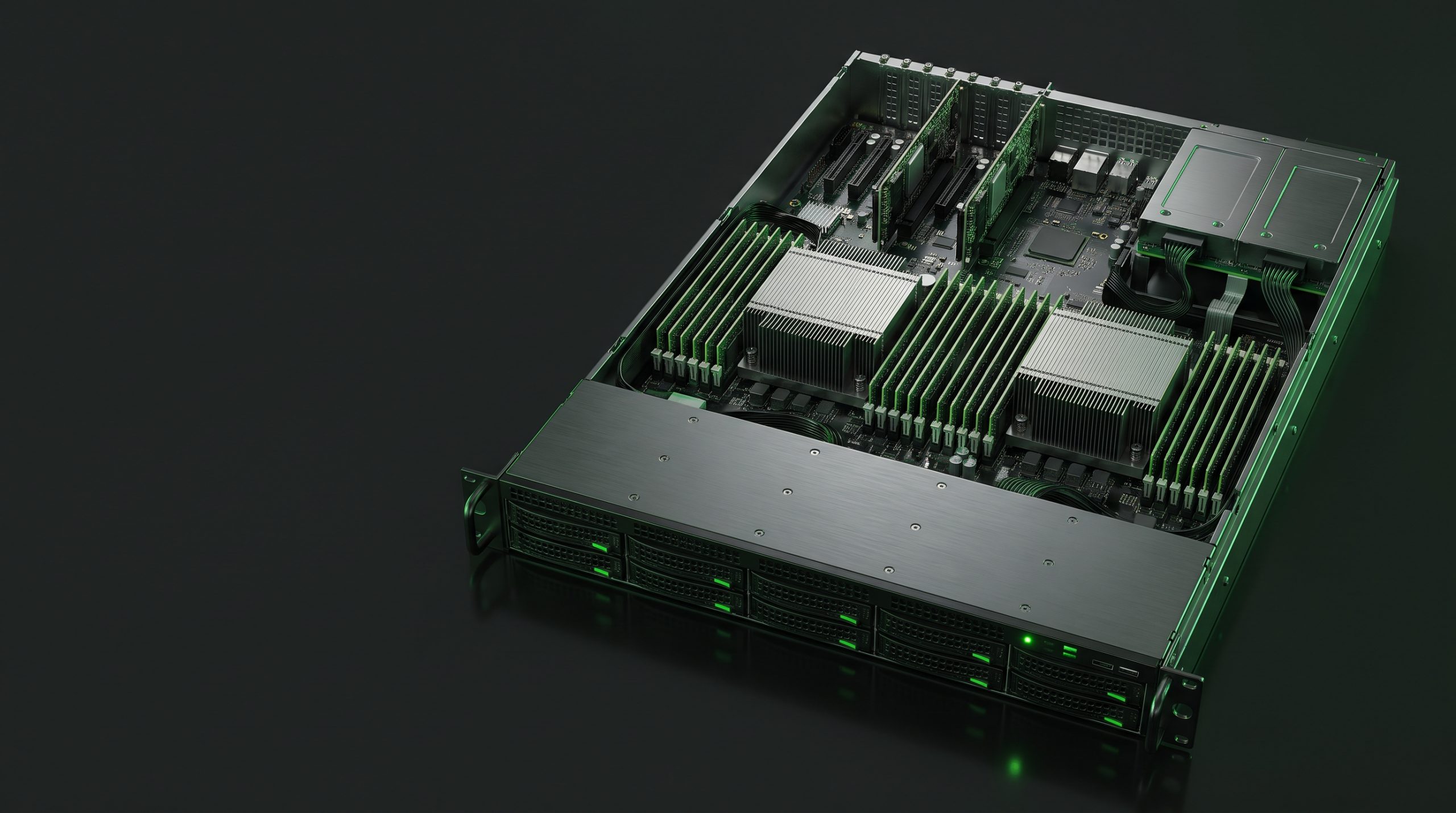
| TL;DR Xeon 6 and EPYC 9005 each list up to 500 W per CPU and up to 12 memory channels. SQL Server and VMware are licensed per core, so the core count affects licence cost as well as speed. This guide looks at four workloads: licensed databases, virtualisation hosts, GPU (graphics processing unit) hosts and CPU inference. Does the rack power plan use whole-server wall power or only the CPU figure? |
This EPYC vs Xeon dedicated server guide compares Intel Xeon 6 with AMD EPYC 9005 and notes the newest AMD parts. AMD announced general availability of its 6th Gen EPYC SP7 processors on 10 November 2026. Intel lists Xeon 6 with up to 12 memory channels and up to 500 W per CPU. AMD lists EPYC 9005 with 12 DDR5-6400 channels and up to 500 W per CPU.
The two families differ in core counts, PCIe lanes and AI instructions, and some software is licensed per core. This guide is for IT heads and infrastructure leads at Indian enterprises who are specifying a dedicated server for a known workload. It compares the two families by fit for four jobs: per-core licensed databases and enterprise resource planning (ERP), virtualisation hosts, GPU hosts and CPU inference. After that, it covers power per rack and the questions to put to a provider about availability.
If you are still deciding whether a dedicated server is the right tier, start with our comparison of shared, VPS and dedicated hosting. Our earlier post on why choose a Xeon dedicated server made a single-vendor case. This one weighs both vendors on current parts.
What Xeon 6 and EPYC 9005 Publish on Their Datasheets
Intel sells Xeon 6 with two core designs. Its Xeon 6 product brief lists up to 128 P-cores or up to 288 E-cores per socket, with up to 12 memory channels on both. AMD’s EPYC 9005 series offers up to 192 Zen 5 or Zen 5c cores. The EPYC 9005 datasheet gives every part 12 DDR5-6400 channels and 128 PCIe Gen 5 lanes, rising to 160 lanes in two-socket servers.
DDR5 is the fifth generation of double data rate server memory. PCIe (Peripheral Component Interconnect Express) lanes are the links that carry data between the CPU and GPUs, NVMe (Non-Volatile Memory Express) drives and network cards. More lanes mean more of those devices can connect at full width.
| Criterion | Intel Xeon 6 | AMD EPYC 9005 |
|---|---|---|
| Cores per socket | Up to 128 P-cores or 288 E-cores; up to 86 on the 6700 and 6500 P-core series | 8 (EPYC 9015) to 192 (EPYC 9965) |
| Memory | Up to 12 channels (eight on the 6700 and 6500 P-core series); DDR5-6400; multiplexed rank DIMMs (MRDIMMs) up to 8,800 megatransfers per second (MT/s) | 12 channels on every part; DDR5-6400 needs original equipment manufacturer (OEM) enablement and a basic input/output system (BIOS) update |
| PCIe 5.0 lanes | Up to 136 in one-socket designs; up to 192 in two-socket servers | 128 per socket; up to 160 in two-socket servers |
| Sockets per server | P-cores: one, two, four or eight; E-cores: one or two | One or two |
| Power per CPU | Up to 500 W thermal design power (TDP) | 125 W (EPYC 9015) to 500 W (EPYC 9965) TDP |
| AI and vector instructions | Advanced Matrix Extensions (AMX) for 8-bit integer (INT8), bfloat16 (BF16) and 16-bit floating point (FP16); Advanced Vector Extensions 512 (AVX-512) on P-core parts only | AMD positions its high-frequency parts for CPU inference and GPU hosts |
Sources: Intel Xeon 6 product brief; Intel Xeon 6700 and 6500 series P-core product brief; AMD EPYC 9005 datasheet and series page. Figures as of 13 Nov 2026.
The rows show the top of each range, not one server. A dedicated server ships with one specific model, and that model sets the cores, power and lanes in the quote. For licensed software, the row that matters is cores per socket, which the next section turns into licence counts.
AMD has also added a newer generation. AMD says 6th Gen EPYC SP7 platforms are now shipping from server OEMs and original design manufacturers (ODMs), as announced on 10 November 2026. In the same release, it lists the EPYC 9996 at 256 cores and 600 W. AMD now calls that figure Default CPU Power instead of TDP.
WHAT TO VERIFY
|
How Do Per-Core Licences Change the EPYC or Xeon Choice?
Per-core licences make the core count a cost decision as well as a speed decision. Microsoft sells SQL Server per-core licences, and Broadcom licenses VMware Cloud Foundation and vSphere Foundation per physical core. How few cores can carry the load of the licensed database or ERP stack?
SQL Server
Microsoft’s SQL Server 2022 pricing page sells Enterprise and Standard per-core licences in 2-core packs, so licensed cores are bought in pairs. The edition limits below come from Microsoft’s separate page for SQL Server 2025.
Microsoft caps what one instance of the cheaper edition can use. In SQL Server 2025, Standard edition is limited to the lesser of 4 sockets or 32 cores, with a 256 GB buffer pool. Enterprise edition goes up to the operating system maximum. As a result, one SQL Server 2025 Standard instance on a 64-core EPYC 9555 can use only 32 of its cores.
VMware
Broadcom’s core counting rule for VMware Cloud Foundation and vSphere Foundation licenses every physical core, with a minimum of 16 cores per CPU. An 8-core EPYC 9015 therefore counts as 16 cores. On the same rule, a two-socket host with two 96-core parts counts as 192.
Fewer, faster cores
ITdaily notes that a database licensed per core costs less on one fast core than on two slower cores with the same computing power. AMD’s datasheet describes high-frequency EPYC 9005 products. Its model table includes F-suffix parts such as the EPYC 9175F, with 16 cores, a 5.00 GHz maximum boost and 512 MB of L3 cache at 320 W.
How many cores a given database needs is a sizing step. Our database server capacity planning guide covers CPU, RAM and storage for it.
EVIDENCE TO REQUEST
|
EPYC vs Xeon Dedicated Server Fit by Workload
Each workload below is matched to one CPU property. The four sections that follow take them in turn.
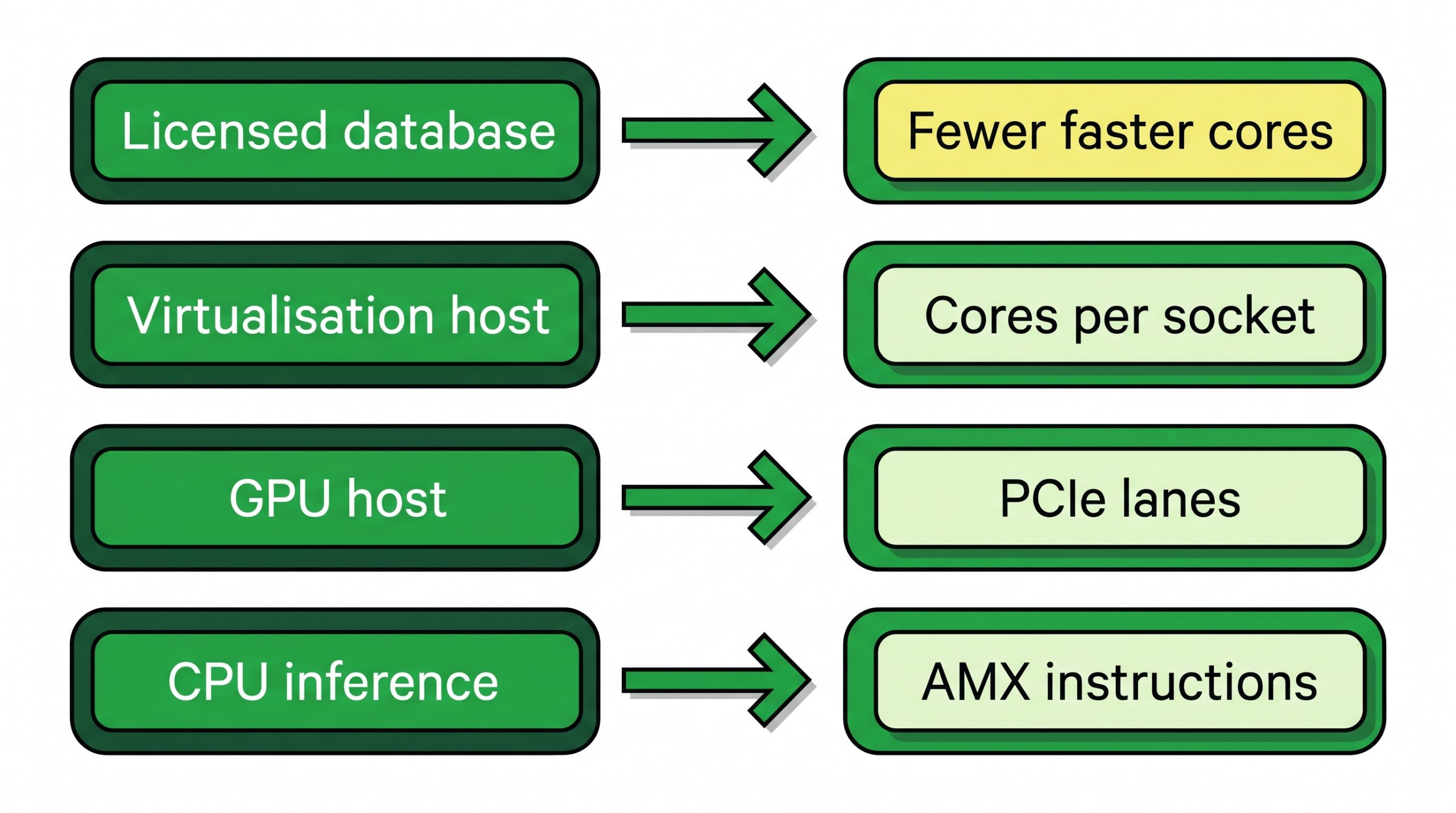
Figure 1. The four workloads in this guide and the CPU property each section examines: licensed database, fewer faster cores; virtualisation host, cores per socket; GPU host, PCIe lanes; CPU inference, AMX instructions.
Per-core licensed database or ERP
For SQL Server or an ERP database licensed per core, fewer faster cores keep the licence count down. How do the AMD F parts perform on the actual query load? Which Xeon 6 P-core models with low core counts and high clock speeds are in the quote? And does the Standard edition cap rule out anything above 32 cores?
Virtualisation host
At one core per virtual CPU (vCPU), more cores per socket means more vCPUs per host. AMD states that its 192-core EPYC 9965 supports 33 percent more vCPUs than Intel’s 144-core Xeon 6E part. Intel’s E-core Xeon 6 range now lists up to 288 cores per socket. Does the comparison in the quote include that model?
Under VMware, every one of those cores is licensed. Will the virtual machine (VM) count grow with the cores licensed?
GPU host
Does the server have enough PCIe lanes for every accelerator, NVMe drive and network card? If each GPU takes a x16 link, eight GPUs use 128 lanes before storage and networking. AMD’s datasheet positions high-frequency EPYC 9005 parts for feeding GPU-accelerated workloads. By contrast, Intel describes Xeon 6 P-cores as the host CPU of choice for leading AI accelerator platforms.
Why AI teams move these servers to single-tenant hardware is covered in why AI workloads need dedicated bare metal servers.
CPU inference
AMX instructions let the CPU core itself run the matrix maths behind AI models. Intel says AMX speeds up INT8 and BF16 inference and supports FP16-trained models. Intel lists AMX and AVX-512 on P-core parts only. For E-core parts, it lists Advanced Vector Extensions 2 (AVX2) with Vector Neural Network Instructions (VNNI) and fast BF16 and FP16 conversion.
AMD, for its part, positions its high-frequency EPYC 9005 parts for CPU-based AI inference. Have your own model and framework been tested on both families?
How Much Rack Power Does a Dual-Socket Server Draw?
It draws more than the CPU figure suggests. Xeon 6 and EPYC 9005 both list up to 500 W per CPU, so two sockets can carry 1,000 W of processor power alone. Memory, drives, fans, network cards and GPUs come on top.
AMD has published one estimate of how this plays out. For an EPYC 9996 server with 16 DDR5-8000 registered memory modules (RDIMMs) per socket in an agent-sandbox scenario, AMD estimates 830 W per socket for the processor and memory combined at default provisioning. In that analysis, AMD models a 35 kW rack with room for 20 servers. Only 16 of them fit the power budget at default provisioning.
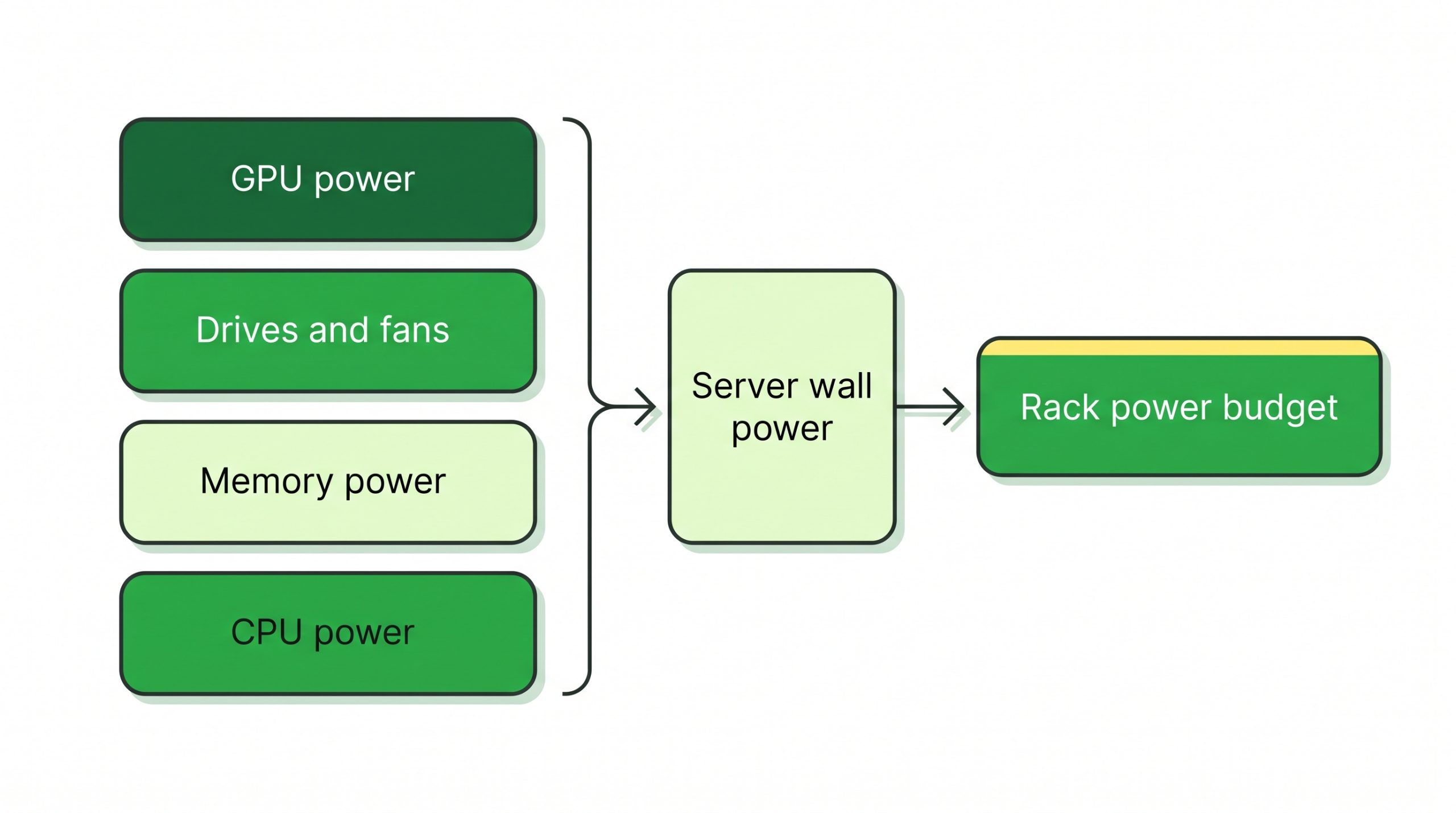
Figure 2. CPU power, Memory power, Drives and fans, and GPU power add up to Server wall power, which is the figure to check against the Rack power budget.
Does the same arithmetic apply to the build in the quote, given the power cap on the rack? Lower-power parts exist in both ranges. AMD’s datasheet lists the 8-core EPYC 9015 at 125 W and the 32-core EPYC 9335 at 210 W. In its 6700 series brief, Intel’s test notes list the 86-core Xeon 6787P at 350 W TDP.
Would a lower-power part leave power headroom for GPUs in the same rack?
WHAT TO VERIFY
|
Where Each Choice Is the Wrong Fit
One SQL Server 2025 Standard instance uses at most 32 cores, so a high-core part is the wrong fit for it. Under VMware, a small 8-core part still counts as 16 licensed cores. Intel lists no AMX or AVX-512 support on E-core Xeon 6 parts.
Socket count draws another line. Intel’s 6700 series brief lists support for up to eight sockets for in-memory databases and mission-critical workloads. A server that needs more than two sockets narrows the choice to Xeon 6 P-cores, because AMD lists EPYC 9005 for one-socket and two-socket servers.
Have memory, storage and network been sized alongside the CPU, and has the software vendor certified a brand-new generation yet?
| Criterion | Why it matters | What to verify |
|---|---|---|
| Core count | Per-core licences scale with it | Licensed cores per server in the quote |
| Licence caps | SQL Server 2025 Standard uses at most 32 cores per instance | Edition and cores per instance |
| PCIe lanes | GPUs, NVMe drives and network cards share them | Usable lanes per slot |
| AI instructions | Intel lists AMX and AVX-512 on Xeon 6 P-cores only | Results on your own model |
| Power | Xeon 6 and EPYC 9005 list up to 500 W per CPU before other parts | Wall power per server and per rack |
| Generation | AMD announced 6th Gen EPYC general availability on 10 Nov 2026 | Exact model and delivery window |
Choosing the CPU for Your Next Dedicated Server
Two questions frame the choice: which licence model applies, and which workload the server will carry. EPYC 9005 fits when you want 12 DDR5-6400 channels on every part and up to 192 Zen 5c cores per socket in a one-socket or two-socket server. Xeon 6 fits when you need AMX for CPU inference, more than two sockets, or up to 288 E-cores per socket. When software is licensed per core, the core count sets the licence count whichever brand you choose.
| NEXT STEP Share your workload, licence model and rack power budget with our team to discuss a high-performance dedicated server configuration for it. |
FAQs
What is an MRDIMM and does a Xeon 6 server need one?
An MRDIMM is a multiplexed rank memory module that Xeon 6 supports alongside standard DDR5. Intel says MRDIMMs can deliver more than 37 percent greater memory bandwidth than RDIMMs. Intel points to bandwidth-constrained AI and high-performance computing use cases. Does the quoted server use MRDIMMs or standard RDIMMs?
Is there an entry-level Xeon 6 for a small dedicated server?
Yes. Intel positions the Xeon 6300 series for entry-level servers. It supports two channels of DDR5 memory at up to 4,800 MT/s and 16 lanes of PCIe 5.0.
Should I wait for 6th Gen EPYC for a new dedicated server?
Waiting is not needed for availability, because AMD says 6th Gen EPYC SP7 platforms are already shipping from server vendors. The choice over EPYC 9005 comes down to the workload; the EPYC 9996, for example, lists 256 cores at 600 W Default CPU Power. Does the software vendor support the new generation, and can the provider deliver it within the project window?