| TL;DR NITI Aayog released its Data Centre Evaluation Framework for states on 14 Oct 2026, with pillars that include power and energy, water and cooling, and siting. For power, its minimum approval documents start with a Power Readiness and Ramp-up Plan; design and operating power usage effectiveness (PUE) are separate evaluation criteria. A buyer can ask a provider for measured values on stated boundaries, not only design targets. A buyer can also ask which dated utility milestone backs each expansion claim. |
What evidence supports a provider’s claims about power availability, cooling efficiency and future expansion capacity? A useful starting point is NITI Aayog’s Data Centre Evaluation Framework, released in October 2026. The framework outlines the documentation states should collect before approving a data centre. This guide interprets those requirements from a buyer’s perspective, helping organisations understand what evidence to request before selecting a provider.
Designed for CTOs, infrastructure heads and procurement teams evaluating data centre providers for GPU rack deployments, this guide translates the framework’s power, water and capacity requirements into a practical document checklist and explains what to look for in each record. It focuses on evaluating provider claims rather than facility design. For the technical requirements of an AI-ready facility, refer to our guide to what makes a data centre GPU-ready for AI workloads.
What NITI Aayog’s Data Centre Evaluation Framework Requires States to Verify
NITI Aayog’s Frontier Tech Hub released the Data Centre Evaluation Framework on 14 October 2026, developed with inputs from industry, the Ministry of Electronics and Information Technology (MeitY), the Ministry of Power and the Department for Promotion of Industry and Internal Trade (DPIIT). It is built on five pillars: Power and Energy; Water and Cooling; Siting and Environmental Sustainability; Economic and Strategic Value; and Policy, Governance and Implementation.
The framework is guidance for state governments, not a new regulation. Each pillar closes with recommended minimum approval documents, the core records a state should obtain before approval to confirm resource readiness, safeguards and measurable commitments. Those documents, along with the framework’s evaluation criteria, are what this guide borrows.
Two proposals point towards verification. The framework asks the Centre to set up a central audit mechanism, with MeitY as nodal ministry, to periodically audit or inspect data centres’ claims, and it asks the Bureau of Energy Efficiency (BEE), the Bureau of Indian Standards (BIS) and MeitY to standardise how PUE, WUE and CUE are measured, reported and verified. These are power, water and carbon usage effectiveness, ratios that compare a facility’s total electricity, water and emissions with what its IT equipment alone consumes.
MeitY told a parliamentary committee that it maintains no official data on data centre capacity. On the industry side, Uptime Institute’s 2025 survey found that collection and reporting of key sustainability metrics did not improve in 2025.
The framework also asks states to classify each proposal as conventional colocation, AI, high-performance computing (HPC) or GPU compute, or hybrid, and to assess power, cooling and infrastructure against that facility type. The PIB release describes this as distinguishing colocation from active compute services. A buyer can ask the same question of any hall on offer: was it planned and approved as GPU compute, or as conventional colocation?
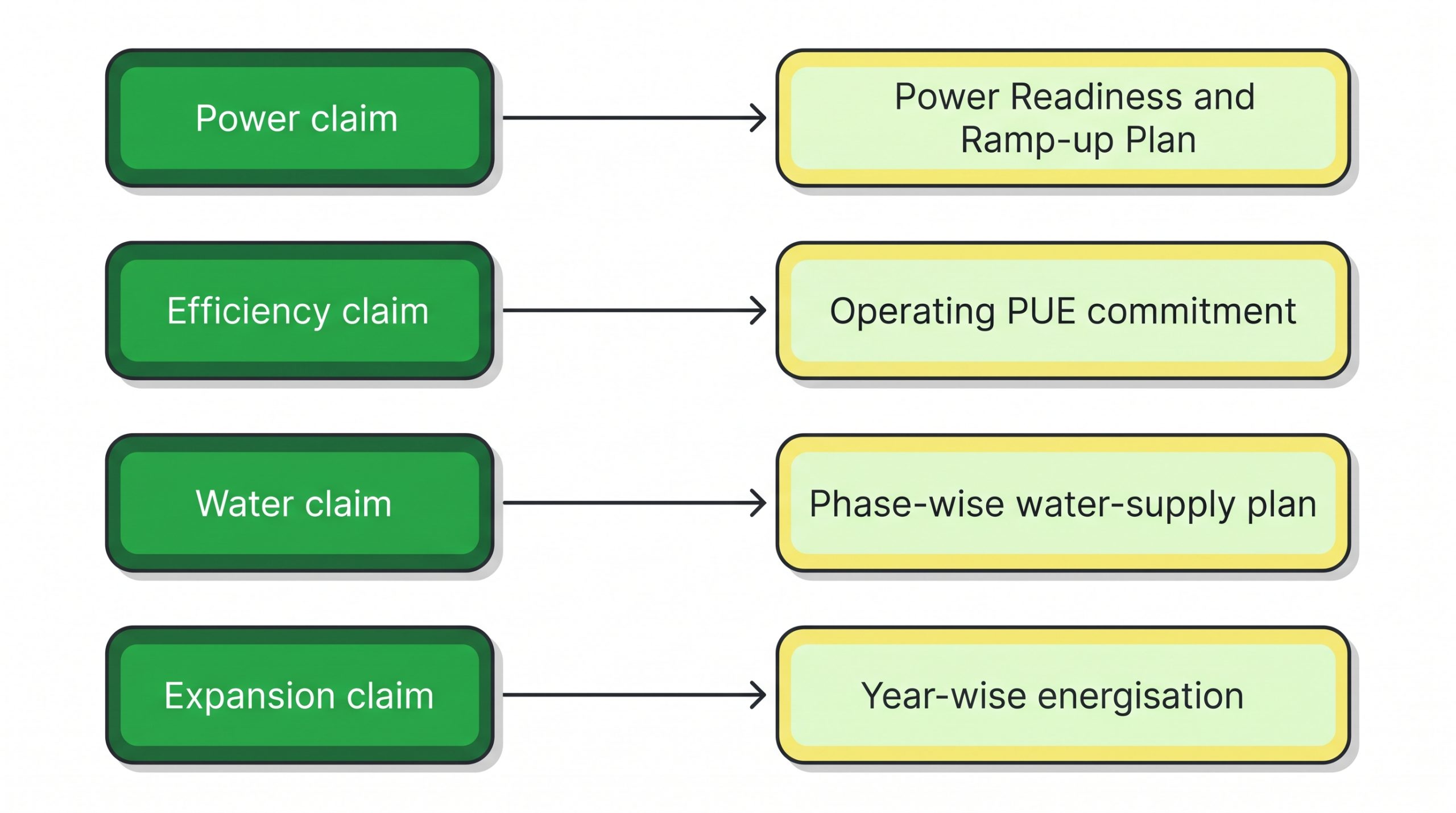
Figure 1. Each common provider claim maps to something the framework asks states to check: a power claim to the Power Readiness and Ramp-up Plan, an efficiency claim to the design and operating PUE criteria, a water claim to the phase-wise water-supply plan and an expansion claim to year-wise energisation.
Which Power Documents Show a Provider Can Energise Your Racks?
The central record is a Power Readiness and Ramp-up Plan, validated jointly by the developer, the distribution company (DISCOM) and the state transmission utility (STU). The framework expects it to cover total campus demand, built capacity, expected utilisation, sanctioned MW, year-wise energisation, substation and transmission augmentation, lead times and the party responsible for each upgrade. Can the provider share its own version of this plan, or the utility sanction behind it?
The framework goes further than a headline MW figure. It asks states to record firm MW, the connection point and the sanction stage, and to align each capacity milestone with confirmed substation and transmission lead times. It calls for DISCOM and STU load-flow studies covering feeder limits and N-1 or N-2 contingency, that is, whether supply holds if one or two network elements are out of service, and for verification of independent upstream sources where a site claims dual feeds.
The framework adds three further points. For facilities above 20 MW, it asks for automated demand-response readiness and integration with State Load Despatch Centre (SLDC) telemetry and control. It recommends approving load enhancement only after the supporting assets are commissioned. And it counts renewable or storage-backed reductions in grid draw only where hourly or time-block matching, contracted quantum, commissioning and metering are confirmed.
| EVIDENCE TO REQUEST DISCOM sanction or approval showing sanctioned MW for the site, with its date and sanction stage. Year-wise energisation schedule for the hall you will occupy. Summary of the load-flow or connection study, including the case where one network element is out of service, and the upstream sources behind any dual feed. For renewable claims: contracted quantum, matching basis (hourly or time-block) and metering point. For campuses above 20 MW: status of demand-response and SLDC telemetry integration, and the operating procedure during curtailment. |
How Should a Buyer Read PUE and WUE Claims?
The framework separates modelled design PUE from the operating PUE the developer commits to, and asks for the assumptions behind both for climate, rack density, cooling, uninterruptible power supply (UPS) and backup configuration. A buyer can ask a provider for the same three items. Is the quoted figure a design value or a measured operating value, over what period, and where do the meters sit?
The definitions come from international standards. PUE is defined in ISO/IEC 30134-2, whose second edition was published in January 2026 and which covers how to measure, calculate and report PUE. The standard also defines designed PUE, a projected value set by the data centre’s design targets. Water usage effectiveness is defined in ISO/IEC 30134-9:2022, which quantifies a data centre’s water consumption during its use phase.
The framework’s cross-pillar condition asks states to assess design-stage PUE, WUE and CUE against published BIS standards and to require post-commissioning measurement and reporting using the same boundaries, the pairing shown in Figure 2.
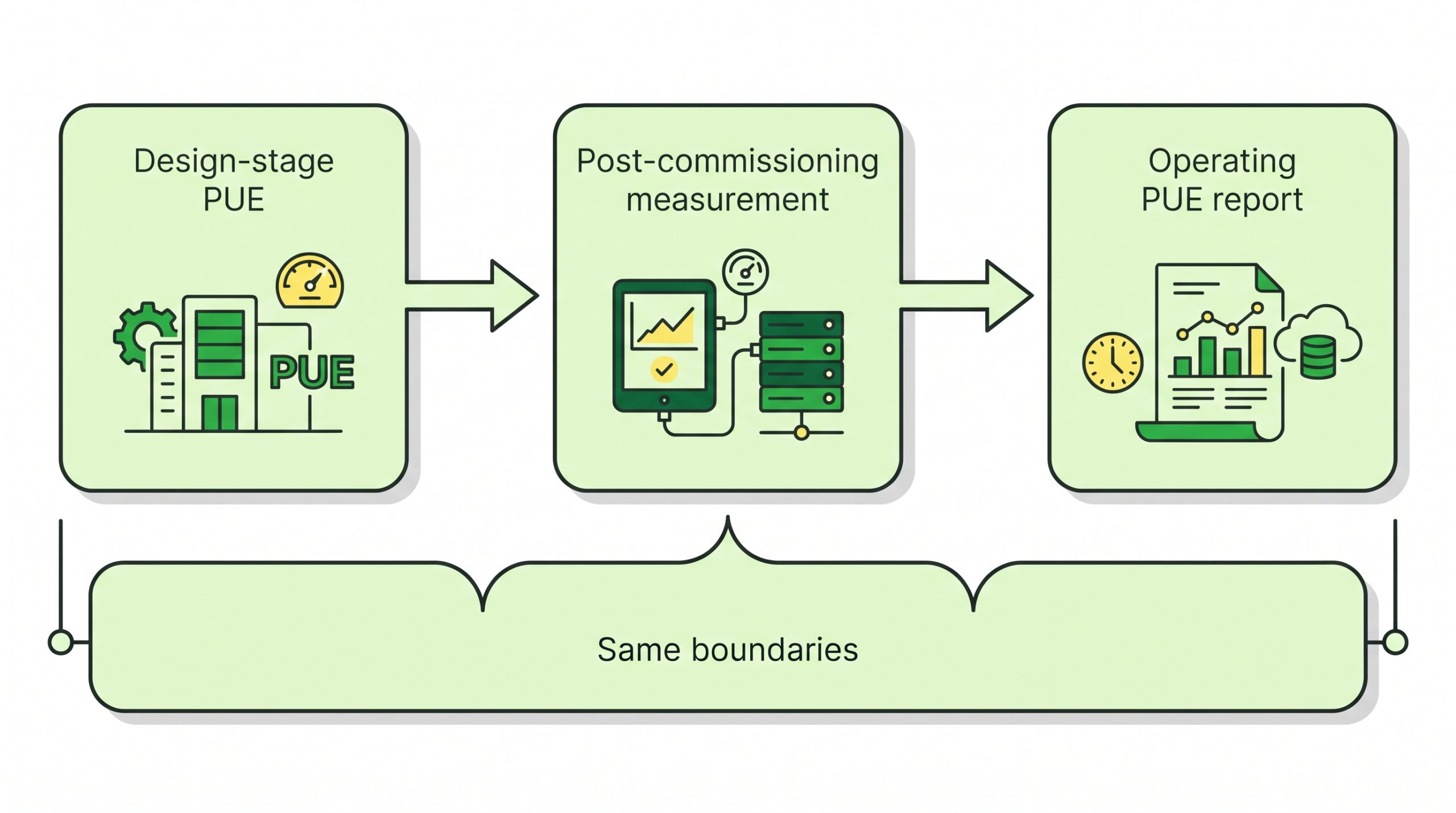
Figure 2. The framework pairs design-stage PUE with post-commissioning measurement and an operating PUE report on the same boundaries. A buyer can check whether a provider’s design and operating figures follow the same pairing.
For context on what operators report, Uptime Institute’s 2025 survey put the average PUE at 1.54, with facilities commissioned in the previous five years at 1.48 and those above 20 MW around 1.44. These are global averages from Uptime Institute’s 2025 survey; Uptime notes that improvement is constrained by legacy infrastructure and region-specific barriers to efficient cooling.
The framework applies the same approach to water. It asks for fit-for-use water specified separately for facility-level and rack-level cooling, distinguishing air cooling, water cooling, rear-door heat exchangers, direct liquid cooling and immersion. It asks for peak-summer demand and WUE modelled at local conditions, including approximately 40°C where applicable, and for a phase-wise water-supply plan covering peak demand, contracted supply, recycled sources, on-site storage and metering. Recycled or treated supply is deducted only when it is contracted and connected.
How cooling choice affects is covered in our post on Varuna and water-conscious AI infrastructure.
| WHAT TO VERIFY Is the quoted PUE a design value or a measured operating value, and over what period? Where is IT energy metered: UPS output, power distribution unit (PDU) or server input? Are design and operating figures measured on the same boundary? What is WUE at peak summer, and which sources supply it: municipal, groundwater or treated wastewater? Is there a phase-wise water-supply plan with metering for the phase you will occupy? Which cooling type serves your hall: air, rear-door, direct liquid or immersion? |
Testing Capacity and Expansion Claims Against Your Growth Plan
The PIB release puts India’s data centre capacity at about 375 MW in 2020 and approximately 1.5 GW as of October 2026, while MeitY, as MediaNama reports, has told a parliamentary committee that it maintains no official capacity data. The table below maps each common claim to the framework requirement and the evidence to ask for.
| Claim you hear | What the framework asks states for | Evidence to request from the provider |
|---|---|---|
| MW available on campus | Firm MW, connection point and sanction stage (Pillar 1) | Sanctioned MW and the energised share for your hall |
| Ready to expand next year | Year-wise energisation aligned with confirmed substation and transmission lead times (Pillar 1) | The phase date and the utility milestone it depends on |
| A PUE figure | Modelled design PUE, operating PUE and assumptions; post-commissioning measurement on the same boundaries | Measured operating PUE, period and metering boundary |
| Water-efficient cooling | Peak-summer WUE at local conditions and a phase-wise water-supply plan (Pillar 2) | Peak WUE, water sources and metering arrangements |
| Green or renewable power | Hourly or time-block matching, contracted quantum and metering (Pillar 1) | Contract quantum, matching basis and metering point |
| GPU-ready hall | Facility classified as conventional colocation, GPU compute or hybrid, and assessed against that type | How the hall was classified and the rack power and cooling it was assessed for |
Sources: NITI Aayog Data Centre Evaluation Framework (14 Oct 2026); PIB release (15 Oct 2026).
The middle column shows what the framework asks a state to assess or obtain. Can the provider answer the right-hand column with hall-level, measured records, or only with design targets and campus totals?
How the checklist applies depends on the deployment:
- Inference pilot on a few racks. A buyer can ask whether the hall’s power is energised today and on what boundary the quoted PUE is measured.
- Training cluster growing in phases. A buyer can ask for year-wise energisation against the cluster roadmap, since the framework recommends load enhancement only after supporting assets are commissioned, and how demand response applies if the campus is above 20 MW.
- Regulated workload, for example banking, financial services and insurance (BFSI) under the Digital Personal Data Protection Act (DPDP Act). The framework’s Condition 14, as reported by MediaNama, asks states to map the facility and IT owner, workload controller, Data Fiduciary or Processor and compute controller. A buyer can ask the provider where it would sit in that map for the contract.
If the constraint you are hitting is rack power or cooling headroom rather than documentation, our post on signs your AI infrastructure has outgrown traditional colocation covers that decision.
Limits of this approach. The framework advises states; it does not bind providers, and its central audit mechanism is a proposal. It asks BEE, BIS and MeitY to standardise PUE, WUE and CUE boundaries. The Uptime averages above are global rather than Indian. Which of these records will be checked on a site visit, and which are written into the contract?
| Criterion | Why it matters | What to verify |
|---|---|---|
| Power readiness | The framework links approval to verified readiness of power | Sanctioned MW, sanction stage, energisation year for your hall |
| Grid resilience | The framework asks for load-flow studies covering loss of one or two network elements and independent sources for dual feeds | Connection study summary and upstream sources |
| Efficiency | Design and operating PUE are compared on the same boundaries | Measured PUE, period, metering point |
| Water | WUE is modelled at peak summer and water supply is planned by phase | Peak WUE, sources, water-supply plan with metering |
| Expansion | Capacity milestones align with substation and transmission lead times | Phase dates and the utility milestone behind each |
FAQs
Is India’s national data centre policy the same as the NITI Aayog framework?
No, they are separate. The government has said a dedicated data centre policy is coming to keep the sector from raising household power bills, without giving its provisions or a publication date. Will any of its provisions apply to a contract signed before it is published?
Which Indian states already have data centre policies?
Reports that states including Uttar Pradesh, Gujarat and Karnataka already run their own data centre policies. The NITI Aayog framework describes itself as guidance and does not prescribe a uniform approach.
Will WUE be reported by water source?
The framework lists source-wise WUE reporting among the tasks it proposes at the central level. It is a proposal rather than a current requirement. Does the provider already split WUE by water source, or report one site figure?
Choosing a Provider on Evidence, Not Headlines
The framework was written for states, but its records map onto provider claims: sanctioned MW and a dated energisation plan for power, measured values on stated boundaries for efficiency and water, and utility milestones for expansion.
| NEXT STEP Planning GPU racks and want to review power, cooling and expansion evidence for your deployment? See RackBank AI Colocation for high-density GPU racks. |