TL;DR
- The managed vs unmanaged dedicated server decision is not about server quality. Both give you the same bare metal. What changes is who carries the operational load.
- A managed dedicated server moves monitoring, patching, incident response and security management to the provider. An unmanaged dedicated server leaves all of it with your team.
- Compare total operational responsibility, not the monthly invoice. An unmanaged server with two engineers checking it is rarely the cheaper option.
- Choose managed when workloads are business critical and internal server administration capacity is thin. Choose unmanaged when you have infrastructure engineers who want direct control of the environment.
Most teams evaluating dedicated server hosting start by comparing cores, RAM and price. Then the first kernel patch lands, or a disk fails at 2 AM, and the real question surfaces: who is actually running this machine?
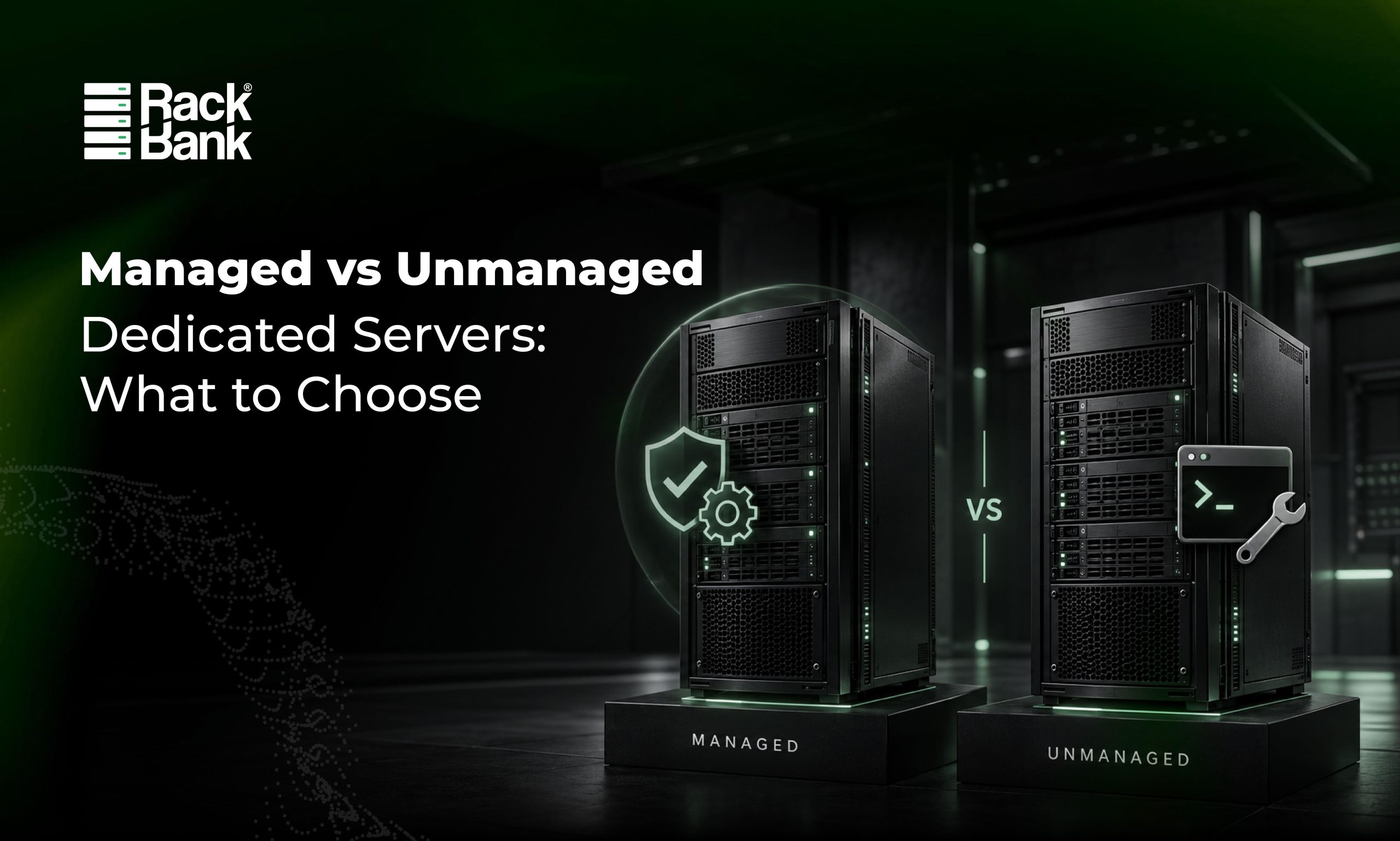
Managed vs Unmanaged Dedicated Servers: What Is the Difference?
A managed dedicated server is a single tenant physical server where the provider takes responsibility for defined operational tasks: monitoring, maintenance, updates, incident response and often security management.
An unmanaged dedicated server is the same hardware, delivered with network and power guaranteed, and nothing above that layer. The provider keeps the server online. You handle everything inside it.
The hardware is identical. The division of responsibility is not.
What Is a Managed Dedicated Server?
Under a managed model, the provider runs real time monitoring on the server, responds to incidents against an SLA, applies OS and software updates, tunes resource allocation, plans capacity ahead of growth and manages hardware lifecycle so ageing components get replaced before they fail. Security monitoring and compliance documentation usually sit here too. Your team consumes the server. Someone else operates it.
What Is an Unmanaged Dedicated Server?
With unmanaged dedicated server hosting, your administrators own the OS install, package management, patching, firewall and hardening, backups, log review and troubleshooting. There is no queue to escalate into beyond hardware and connectivity faults. That is the cost, and for some teams it is also the point: full root level control with no provider process in the way.
Key Differences at a Glance
| Factor | Managed Dedicated Server | Unmanaged Dedicated Server |
|---|---|---|
| Server management | Provider handles key tasks | Customer handles tasks |
| Monitoring | Provider managed | Customer managed |
| Maintenance | Provider assisted | Customer responsibility |
| Technical support | Included or available | Usually infrastructure only |
| Security management | Provider can assist or manage | Customer responsibility |
| Updates and patches | Provider managed | Customer managed |
| Control | Shared operational responsibility | Greater hands on control |
| Internal expertise needed | Lower | Higher |
When a Managed Dedicated Server Makes Sense
Managed dedicated server hosting fits when in house IT expertise is limited, when the workload is business critical, and when downtime carries commercial consequence. ERP, CRM, SAP and production database environments are the clearest cases, since they need continuous monitoring, tuning and patch discipline rather than occasional attention. It also fits regulated organisations that need managed security and audit ready compliance evidence, and product teams who would rather spend engineering hours on the application than on the box under it.
When an Unmanaged Dedicated Server Makes Sense
Unmanaged works when you already employ experienced system administrators or a DevOps team, when your stack is custom enough that provider tooling gets in the way, and when your team is genuinely equipped to own monitoring, security and recovery. If you are running your own configuration management and on call rotation, unmanaged gives you cleaner control.
Cost vs Operational Effort
An unmanaged server has a lower monthly line item. It does not have a lower total cost. Add the engineer time spent on patching and maintenance, the on call burden for incident response, security management effort, and the exposure when a failure lands outside working hours. Managed hosting converts variable internal effort into a predictable fixed monthly fee. Price the responsibility, not just the rack unit.
How to Choose
Choose managed if you want provider assisted infrastructure management, need proactive monitoring, have limited server administration resources, or run workloads requiring ongoing support.
Choose unmanaged if you have experienced infrastructure engineers, need direct administrative control, can handle monitoring and maintenance internally, and want to own the server environment end to end.
How RackBank Managed Services Support Dedicated Server Infrastructure
RackBank’s managed services cover three areas. Infrastructure management brings real time monitoring, incident response, resource optimisation, capacity planning and hardware lifecycle management. Database and application management covers SAP and ERP specialists, database optimisation and tuning, plus migration, upgrade and refresh work. Managed security and compliance adds continuous vulnerability assessment and remediation, regulatory compliance management across ISO, SOC 2 and TIA-942, and audit ready documentation. Support runs against defined SLAs for uptime and responsiveness, at transparent fixed monthly fees.
Conclusion
Managed means less infrastructure management responsibility. Unmanaged means more direct control and more operational work. Map the model to your team’s actual capacity, not to the lower invoice, and the choice usually settles itself.
FAQs
What is the difference between managed and unmanaged dedicated servers?
The hardware is the same. In a managed model the provider handles monitoring, maintenance, patching and support. In an unmanaged model your team handles all of it.
Which is better, a managed or unmanaged dedicated server?
Neither is universally better. Managed suits teams with limited server administration capacity. Unmanaged suits teams with experienced infrastructure engineers.
Is an unmanaged dedicated server cheaper?
The monthly fee is lower. Total cost depends on the internal engineering time you spend maintaining it.
Does dedicated server management include security?
With RackBank it does. Managed security covers vulnerability assessment, remediation and compliance documentation.
Can I switch from unmanaged to managed later?
Yes. Server management is a service layer and can be added to existing dedicated server infrastructure.