

TL;DR:
- AI workloads are pushing rack densities past 100 kW. Air cooling stops being viable around 30 kW.
- Varuna is RackBank’s liquid immersion cooling system. It uses zero water in operation. Servers sit fully submerged in a sealed dielectric fluid loop.
- Cooling energy drops by up to 90%. PUE moves from 1.5+ to 1.05.
- For India, where water stress is an active constraint on datacenter siting, this is a policy-relevant design choice, not just a technical one.
- Varuna lets you scale AI compute without scaling water footprint.

The sustainability challenge of AI infrastructure
Every generation of AI models is hungrier than the last. GPUs that drew 300 W five years ago now pull 700 to 1200 W per card. Rack densities that used to top out at 20 kW are now crossing 100 kW. The compute story is well documented. The cooling story is not.
Traditional air-cooled datacenters were designed for a different workload. As AI clusters grow, cooling has quietly become the bottleneck. It limits how dense you can pack a rack, how much power you can deliver to it, and how sustainably you can operate at scale.
The shift from traditional air cooling to liquid cooling
Air is a poor thermal conductor. Liquid is roughly 1000 times better at moving heat. Once racks crossed 30 kW, the industry started shifting toward direct-to-chip cooling. Above 80 kW, even that begins to struggle.
Immersion cooling, where the entire server sits in a tank of dielectric fluid, is what comes next.
What is Varuna?
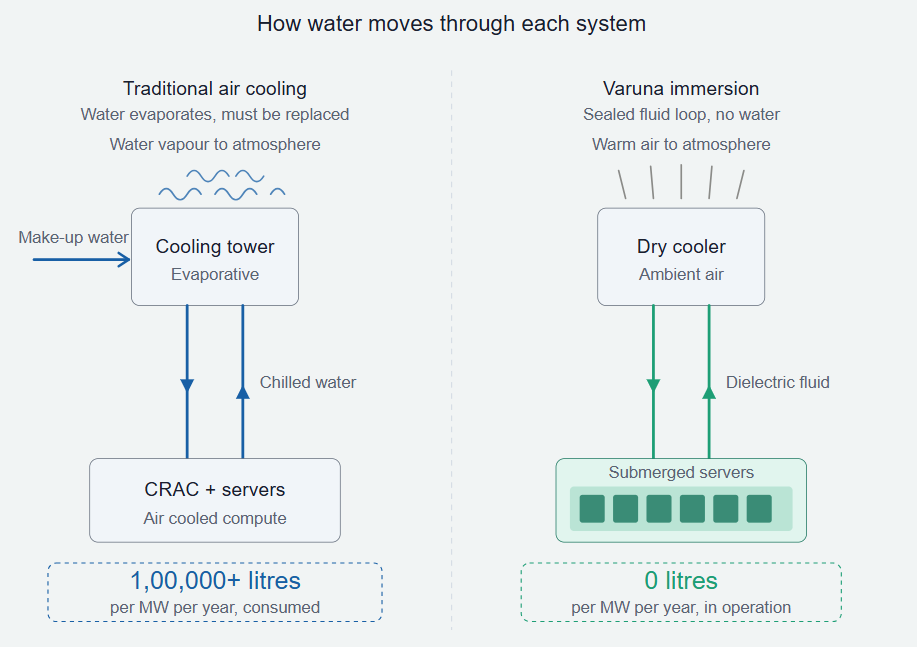
Varuna is RackBank’s single-phase liquid immersion cooling system, designed and built in India. Servers sit fully submerged in a dielectric fluid that is electrically non-conductive, biodegradable, and safe to handle. Heat moves from the components into the fluid, and from the fluid to a closed secondary loop that rejects it outside the building through a dry cooler.
How Varuna enables water conscious AI infrastructure
In a conventional facility, water is consumed continuously through evaporative cooling. In a Varuna deployment, the dielectric fluid is charged once and circulates within the tank for the life of the system. Heat is exchanged with the outdoor environment through a dry cooler that uses ambient air, not evaporation.
The result is a cooling architecture where compute scales freely without scaling water draw.
Benefits of Varuna for modern AI workloads
The performance and sustainability gains come from one source: replacing air with a thousand-times-better thermal medium, in a closed loop.
| Metric | Traditional Air Cooling | Varuna Immersion |
|---|---|---|
| Cooling energy share | 30 to 40% of facility load | 3 to 5% of facility load |
| PUE (typical) | 1.5 to 1.8 | 1.03 to 1.08 |
| Max rack density | 20 to 30 kW | 150 kW and above |
| Water use per MW (annual) | 1 to 5 lakh+ litres | Zero (operational) |
| Hardware thermal stress | High, fan driven hotspots | Low, uniform fluid bath |
A 1 MW AI cluster moving from PUE 1.6 to 1.05 saves roughly 4.8 million kWh per year. At Indian commercial tariffs that translates into meaningful OPEX recovery within the first two years of deployment. Submersion also removes fan vibration and thermal cycling, which extends GPU and SSD service life and reduces throttling on long training runs.
Supporting India’s AI Infrastructure vision
Sustainability targets are no longer optional. Enterprise procurement teams are asking AI vendors for Scope 2 and Scope 3 reporting. Investors are asking the same of operators. A water-free cooling design changes the conversation on both fronts.
This also aligns with India’s push to become a sovereign AI compute hub. Water-conscious infrastructure is a precondition for siting large GPU clusters in tier-2 cities without triggering local resource conflicts.
The future of water conscious AI Datacenters
The next decade of AI infrastructure will be defined by what gets built where, and under what constraints. Power availability and water availability are now equal partners with land cost and connectivity. Immersion cooling is one of the few technologies that addresses both at once: lower power draw, zero operational water consumption, and higher compute density per square metre.
Conclusion
AI cannot be both transformative and wasteful. Varuna is RackBank’s contribution to closing that gap. It is built in India, designed for the densities Indian AI builders will need over the next five years, and engineered to scale without drawing on water resources the country cannot spare
| Planning a high-density AI deployment? Talk to the RackBank infrastructure team about running your workload on Varuna-cooled racks. Buy or rent GPU capacity, with cooling already solved at the rack level. |
FAQs
| Does Varuna use any water? No. The system uses a sealed dielectric fluid loop with a dry cooler for heat rejection. There is no evaporative water consumption during operation. |
| What rack densities does Varuna support? Single-phase immersion configurations support 100 to 150 kW per tank today, with headroom to go higher as GPU TDPs grow. |
| Is the dielectric fluid safe? Yes. The fluid is non-conductive, non-toxic, and biodegradable. It is safe for handling and disposal. |
| How does PUE compare to air cooling? Air-cooled facilities typically run at PUE 1.5 to 1.8. Varuna deployments routinely operate between 1.03 and 1.08. |
| Can existing servers be retrofitted? Most standard servers can be converted by removing fans and replacing any thermal interface materials incompatible with immersion. RackBank handles the conversion process end to end. |