

| TL;DR Pick a colocation provider in India on documents rather than on a site tour and a slide deck: single-line diagrams, access-event exports, duct drawings, certificate scopes and a marked-up SLA. Score the facility you will actually occupy, not the brand above the gate. A provider’s second site can have a different power design, different carriers and a different certification scope. The availability percentage is the least informative number in the contract. The exclusions list and the remedy mechanism carry the real commitment. Weight power and cooling at 25 percent and operational resilience at 20 percent. Those two domains cause most outages, and they are the hardest things to change after your racks are in the hall. |
Selecting a colocation provider in India is a procurement decision wearing technical clothes. The specifications on every provider’s website converge: redundant power, biometric access, carrier neutrality, high uptime, a list of certifications. Read four of them side by side and they are close to interchangeable. The differences that matter show up only when you ask for the document behind each claim, and they show up at the worst possible time if you do not.
This is a vendor evaluation framework rather than a buying guide. It covers seven domains, the specific evidence to request in each, and a weighted scorecard that procurement and infrastructure teams can score together without arguing about what “good” means halfway through the process.
Why colocation provider evaluations in India go wrong
Three failures account for most regretted contracts.
The first is evaluating a provider instead of a facility. Certifications, redundancy designs, carrier mixes and incident histories attach to a specific building. A provider operating four sites may have one that is genuinely well engineered and three that are not.
The second is accepting a design claim as a delivered configuration. A hall built to a 2N standard can still deliver your particular rack through a single busway if nobody asked for the drawing.
The third is leaving commercial terms until after the technical team has picked a favourite. Once the architecture review is done, the power uplift pricing and the escalation clause are no longer negotiable in practice.
The framework below is built to close all three gaps before a contract gets drafted.
The seven-domain evaluation framework
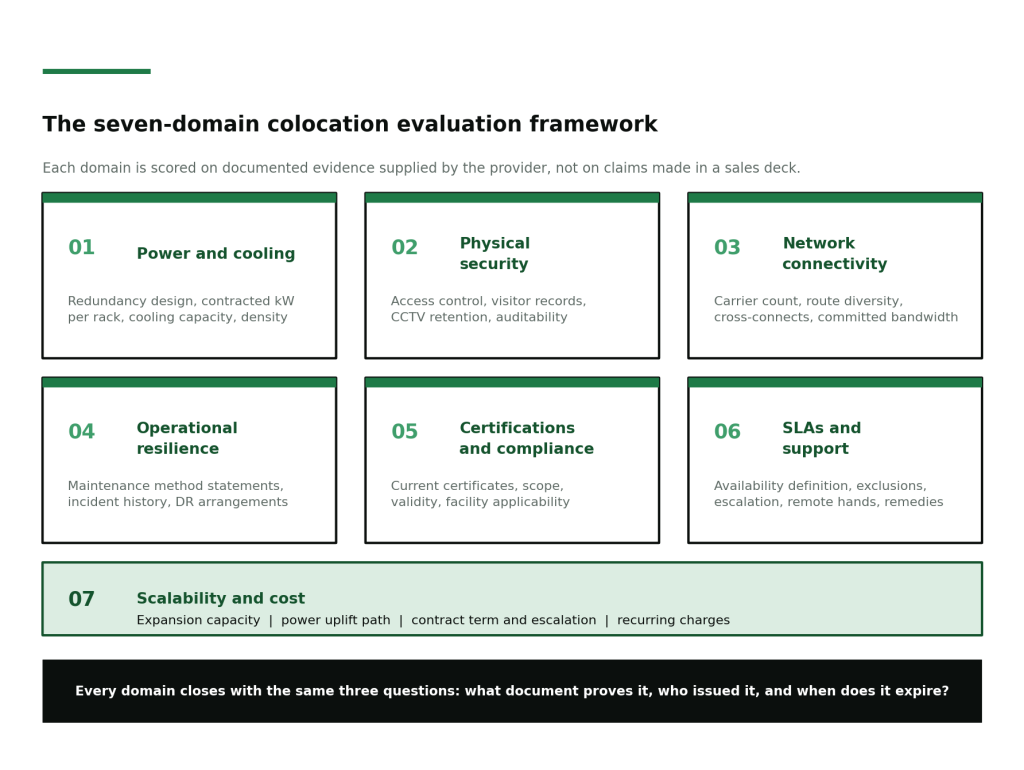
Figure 1. The seven-domain colocation evaluation framework.
Each domain gets a score, a weight and a named document that supports the score. Where no document exists, the score is zero rather than an assumption. That rule alone separates providers faster than any site visit.
1. Power and cooling: the domain that decides everything downstream
Ask for the contracted kilowatts per rack and the single-line diagram for your specific hall. Everything else in this domain follows from those two documents.
Redundancy design
N, N+1 and 2N are often used loosely, and the distinction is not academic. N+1 adds a spare unit at a stage of the power chain. 2N provides two independent paths end to end, dual-corded into your rack. A facility can hold an N+1 UPS configuration and still feed your cabinet through one PDU and one busway, which means a single downstream failure still drops you.
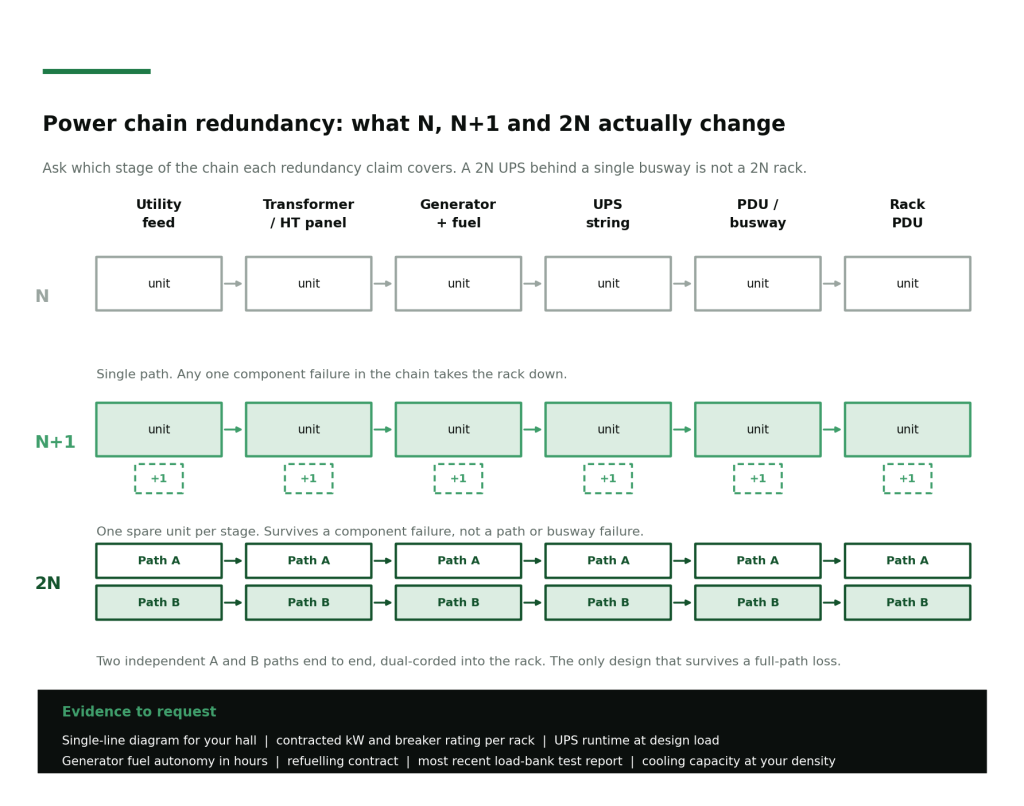
Figure 2. Power chain redundancy: what N, N+1 and 2N change across the full chain.
The question to put in writing is not “is the site 2N” but “at which stages of the chain serving my hall is redundancy present, and where does the last single point of failure sit”.
Power allocation and rack density
Contracted power, breaker rating and actual measured draw are three different numbers, and providers quote whichever suits the conversation. Confirm what you are billed for, what you are permitted to draw, and what happens if you exceed it. Ask whether unused contracted power can be reallocated to a neighbouring rack, and at what notice.
Density is where a general-purpose hall and an AI-capable hall separate. Conventional enterprise racks sit comfortably in the 5 kW to 15 kW band. GPU training and inference nodes do not, and a facility designed around air cooling at 10 kW per rack cannot absorb a 60 kW cabinet by adding fans. If your roadmap includes accelerated compute in the next two years, evaluate against AI colocation built for high-density racks rather than retrofitting later.
Cooling capacity at your density
Cooling is usually evaluated as a technology list, which tells you very little. The useful questions are about capacity and failure behaviour: what is the design cooling capacity for the hall at full occupancy, what is the redundancy on chillers and pumps, how long does the hall stay inside your equipment’s thermal envelope after a cooling failure, and what is the written temperature and humidity commitment at the cold aisle.
| EVIDENCE TO REQUEST single-line diagram for your hall, contracted kW and breaker rating per rack, UPS runtime at design load, generator fuel autonomy in hours plus the refuelling contract, most recent load-bank test report, hall cooling capacity at full occupancy, cold-aisle temperature and humidity commitment. |
2. Physical security: controls are only as good as their records
Every provider lists the same controls. What separates them is whether each control produces a retained, exportable record that would survive your own auditor asking to see it.
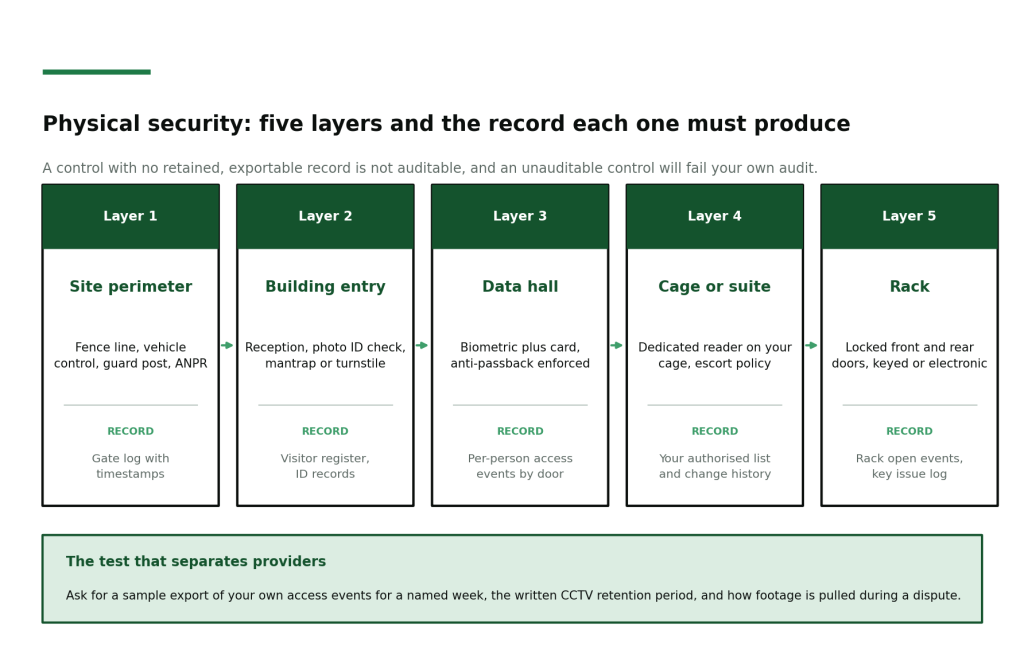
Figure 3. Five layers of physical security and the record each layer must produce.
Access control is the easy part. Visitor management is where gaps appear: who approves a visitor, how long the register is retained, whether ID documents are stored and under what policy, and how quickly an ex-employee is removed from your authorised list. Ask about the removal path specifically, because it is usually manual and usually slow.
CCTV deserves two written answers rather than a yes: the retention period in days, and the process for retrieving footage during an incident or dispute, including who can authorise release and how long it takes. A camera whose footage you cannot obtain within the window of an investigation is a deterrent, not a control.
| EVIDENCE TO REQUEST a sample export of your own access events for a named week, the written CCTV retention period, the footage-release process, the visitor approval and ID-retention policy, and the documented timeline for revoking an individual’s access. |
3. Network connectivity: carrier neutrality is not route diversity
Carrier neutrality means you may buy from multiple carriers. Route diversity means those carriers do not fail together. Many sites offer the first and quietly lack the second.
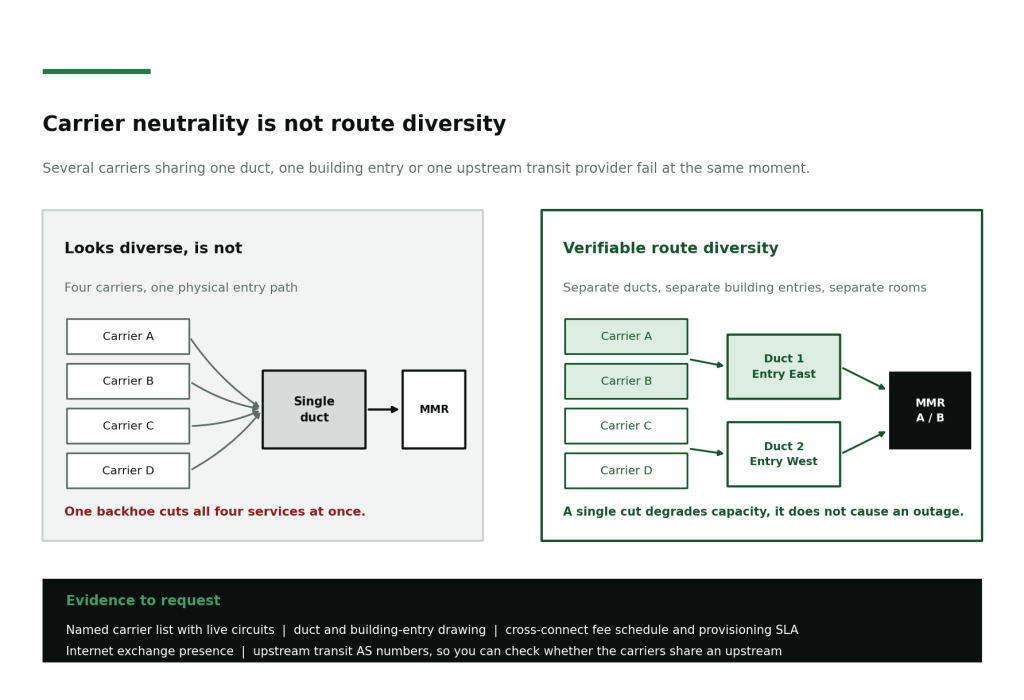
Figure 4. Carrier neutrality compared with verifiable route diversity.
Four carriers entering a building through one duct and terminating in one meet-me room will all go down to a single excavator. Real diversity requires separate ducts, separate building entry points, and ideally separate rooms. Ask for the entry drawing, not a statement.
Two further checks are commonly skipped. First, upstream transit: two carriers reselling the same upstream provider give you commercial diversity and no physical diversity, so ask for the AS numbers and check. Second, cross-connects, which are where colocation economics quietly shift. Confirm the one-time and recurring fee per cross-connect, the provisioning SLA in business days, and whether fees differ for connections to the provider’s own services versus a third-party carrier. For a carrier-neutral data center the answer to that last question should be no.
Internet exchange presence matters for latency-sensitive workloads. Ask which exchanges are reachable on-net and whether the connection is a single hop or transits another facility.
| EVIDENCE TO REQUEST named carrier list with live circuits, duct and building-entry drawing, upstream transit AS numbers, cross-connect fee schedule and provisioning SLA, internet exchange presence and hop count. |
4. Operational resilience: maintenance, incidents and recovery
Resilience is an operational property, not an architectural one. Well-designed facilities fail because of how they are run, and the evidence for how they are run is maintenance records and incident reports.
Ask for the preventive maintenance schedule and a sample method statement for a concurrent maintenance activity on the power chain. A concurrently maintainable design that in practice requires a customer-impacting window is a different product from the one on the brochure, and the method statement is where that shows up.
Then ask for the incident history for your specific facility over the last 24 months, with root cause and corrective action. Expect some resistance, and read the resistance as data. Providers that run disciplined post-incident reviews usually have the documents ready and are willing to walk through them under NDA. A clean sheet is less reassuring than a short list with honest root causes, because no facility of any age has zero events.
Disaster recovery is a separate contract conversation that belongs in this stage. Establish whether the provider can offer a second site at sufficient distance, what the replication path between sites looks like, and who owns failover execution. If your recovery plan depends on hands in the building at 3am, confirm that the managed services and compliance management scope actually covers the actions your runbook assumes.
| EVIDENCE TO REQUESTpreventive maintenance schedule, a sample method statement for concurrent maintenance, 24-month incident history with root causes for the named facility, the post-incident review process, and the DR site options with replication and failover ownership. |
5. Certifications and compliance: scope, validity and the named facility
A certification logo on a website is not evidence. The certificate is. Request the PDF for every standard claimed and check four things on it: the issuing body, the scope statement, the sites listed, and the expiry date.
Scope is where most claims quietly overreach. An ISO 27001 certificate covers a defined information security management system, which may cover the corporate entity and not the hall you are moving into. A certificate listing three sites does not cover a fourth. Match the address on the certificate to the address on your contract.
Terminology deserves care too. TIA-942 Rated 3 and Uptime Institute Tier III are separate schemes from separate bodies with separate audit processes, and “Tier III” used loosely in marketing copy often refers to neither. Ask which scheme, which body and which document.
For Indian enterprises, data residency and the Digital Personal Data Protection Act change what you need from the facility rather than only from the application. Confirm where the data physically sits, which entity acts in which role, what the breach notification path is, and whether subcontracted operations move any data outside the stated jurisdiction. Regulated sectors should additionally confirm the provider’s willingness to support a customer-led or regulator-led audit, and whether that right is written into the agreement or granted case by case.
| EVIDENCE TO REQUESTcertificate PDFs with scope statements and expiry dates, the site list on each certificate, the audit body name, the most recent SOC 2 report if claimed, the written data residency position, and the audit-rights clause. |
6. SLAs and support: read the exclusions before the percentage
The availability figure is the headline, and it is the part of the SLA that carries the least information. Start with what the figure actually measures, then read the exclusions, then read the remedy.
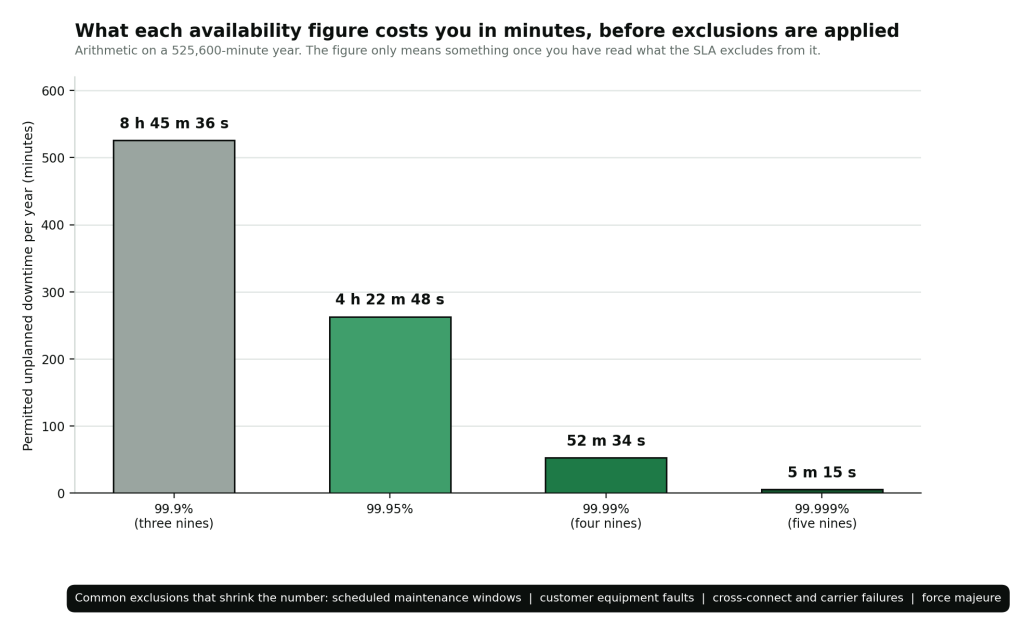
Figure 5. Annual downtime permitted at each availability level, before exclusions.
Availability can be defined at the facility, the hall, the rack feed or the port. Each definition produces a different number from the same year. Confirm which one you are buying, and confirm whether a failure of one path in a 2N feed counts as an outage or as a degradation.
Exclusions do the real work. Scheduled maintenance, customer equipment faults, cross-connect failures, carrier failures and force majeure are all commonly carved out, and a generously drawn scheduled-maintenance clause can remove more hours than the SLA ever promised to protect. Ask for the maintenance notification period and the annual cap on maintenance windows.
Support is where day-to-day experience is decided. Pin down remote hands: what is included in the monthly fee versus billed by the hour, the response time commitment by severity, the rounding increment, whether the rate changes outside business hours, and what the technician is permitted to do without a change ticket. Escalation should be a named matrix with roles and timings, not a single number for the NOC.
Finally, the remedy. Most colocation SLAs remedy breaches with service credits capped at a fraction of a monthly invoice, which is not compensation for an outage and is not meant to be. What matters more is the termination right: how many breaches over what period give you the ability to exit without penalty. That clause is the one with commercial teeth.
| EVIDENCE TO REQUESTthe availability definition and measurement point, the full exclusions list, maintenance notification period and annual window cap, remote hands inclusions and rates with rounding, the escalation matrix, the credit schedule, and the termination-for-breach threshold. |
7. Scalability and cost: price the second year, not the first
Colocation contracts are usually priced attractively at the configuration you sign for and much less attractively at the configuration you grow into. Evaluate the growth path, not the entry point.
Establish the contiguous space available adjacent to your footprint, the lead time to add racks, and whether expansion is guaranteed or offered on a best-efforts basis. A reservation with no contractual backing is a plan, not capacity. Ask the same question about power, which is usually the binding constraint: how much additional kW is available to your hall, what the uplift pricing is, and whether the uplift price is fixed at signature or set at the time of request.
For deployments with a credible multi-megawatt path, the question shifts from rack count to campus. A campus-scale expansion runway in a single location avoids a migration and a second architecture later. Check whether the growth you are being shown is in the same building, the same campus or a different city, since each has a different cost and a different latency profile.
On the commercial side, model the full recurring cost rather than the rack rate: space, contracted power, metered power above contract, cross-connects, remote hands beyond inclusions, and the annual escalation clause. A 7 percent escalator compounds into a materially different number by year three than a 3 percent one. Also check the termination and exit terms, including notice period, hardware removal window and any de-installation charges.
Location is part of this calculation. Latency to users and to the exchanges you peer at is set by geography, so compare sites, not just providers. RackBank, for example, operates facilities in Mumbai, Indore and Raipur, and each carries a different connectivity and cost profile.
| EVIDENCE TO REQUESTadjacent capacity and its contractual status, power uplift availability and pricing with the price-setting mechanism, full recurring charge schedule, escalation clause, notice period, and exit and de-installation terms. |
The evidence request list
Send this as a single annexure with the RFP. Providers that answer it quickly and completely are usually the ones that will operate well.
| Criterion | Why it matters | What to verify |
|---|---|---|
| Power redundancy | Determines whether a single failure reaches your rack | Single-line diagram for your hall, with the last single point of failure marked |
| Power allocation | Billed, permitted and actual draw are different numbers | Contracted kW, breaker rating, overage policy, reallocation terms |
| Rack density | Air-cooled halls cannot absorb accelerated compute later | Design kW per rack, cooling method at that density, highest density in live operation |
| Cooling resilience | Thermal events escalate faster than power events | Hall cooling capacity at full occupancy, chiller and pump redundancy, ride-through time |
| Access control | Controls without records fail your audit, not theirs | Sample access-event export for your own cage, access revocation timeline |
| Visitor and CCTV policy | Retention gaps surface only during a dispute | Written retention periods, footage-release process and authoriser |
| Route diversity | Carrier count is not diversity | Duct and building-entry drawing, upstream transit AS numbers |
| Cross-connect terms | Where colocation economics quietly shift | Fee schedule, provisioning SLA, parity between own and third-party connections |
| Maintenance discipline | Design intent is undone by operating practice | PM schedule, sample method statement for concurrent maintenance |
| Incident history | Past behaviour predicts future behaviour | 24-month incident log with root causes for the named facility |
| Certification scope | Logos cover entities, contracts cover buildings | Certificate PDFs with scope, site list, issuing body and expiry |
| Data residency | Determines your regulatory position, not just theirs | Written residency statement, subcontractor data flows, audit-rights clause |
| SLA definition | Four definitions produce four different numbers | Measurement point, exclusions list, maintenance window cap |
| Remedies | Credits are not compensation | Credit schedule and termination-for-breach threshold |
| Expansion path | Reservations without contracts are not capacity | Adjacent capacity status, kW uplift availability and price-setting mechanism |
| Recurring cost | The rack rate is a fraction of the invoice | Full charge schedule including escalation, exit and de-installation terms |
The weighted vendor scorecard
Agree the weights before the first site visit. Weighting after the visits is how a favourite gets justified rather than chosen.
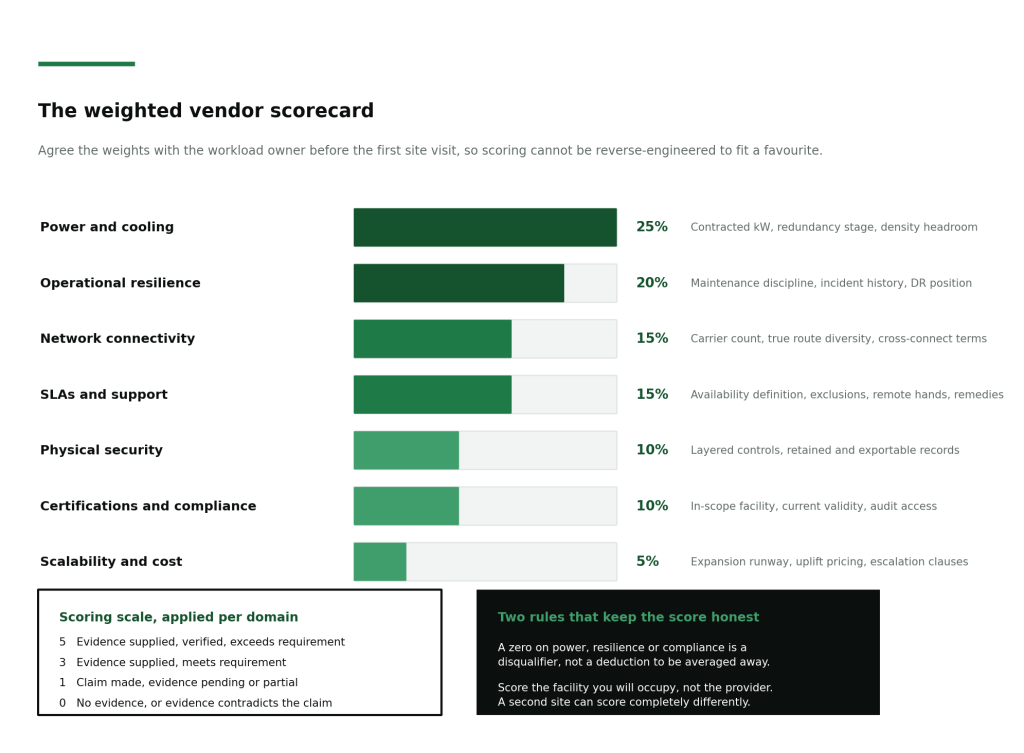
Figure 6. The weighted vendor scorecard: domain weights and scoring scale.
| Domain | Weight | A score of 5 looks like | A score of 0 looks like |
|---|---|---|---|
| Power and cooling | 25% | Diagram supplied for your hall, 2N to the rack, density headroom above roadmap | Verbal assurance only, no diagram, no density figure |
| Operational resilience | 20% | Incident log and method statements shared under NDA, named corrective actions | No incident history offered, or a claim of zero events |
| Network connectivity | 15% | Entry drawing shows separate ducts, distinct upstreams, published cross-connect fees | Carrier logos only, no drawing, fees quoted case by case |
| SLAs and support | 15% | Measurement point defined, exclusions capped, remote hands rates published | Headline percentage with open-ended exclusions and discretionary credits |
| Physical security | 10% | Sample access export produced, retention periods written, revocation timeline defined | Controls described, no records produced |
| Certifications and compliance | 10% | Current certificates naming your facility, audit rights in the agreement | Logos on a website, certificates “available on request” indefinitely |
| Scalability and cost | 5% | Contracted expansion option, uplift price fixed at signature, full charge schedule | Best-efforts expansion, uplift priced at time of request |
Two rules keep the total honest. A zero on power, resilience or compliance is a disqualifier rather than a deduction to be averaged away, because a weighted total can hide a fatal gap behind strong scores elsewhere. And the score belongs to a facility, not a provider, so run the scorecard again for a second site.
Frequently asked questions
How do I evaluate a colocation provider in India before signing?
Score seven domains against documents rather than claims: power and cooling, physical security, network connectivity, operational resilience, certifications, SLAs and support, and scalability and cost. Weight them in advance, request the supporting document for every claim, and score the specific facility you will occupy rather than the provider’s brand.
What should an enterprise check before signing a colocation contract?
Check the single-line diagram for your hall, the contracted kilowatts per rack, the duct and building-entry drawing, certificate scope statements naming your facility, the SLA exclusions list and measurement point, remote hands inclusions and rates, the power uplift mechanism, and the termination-for-breach threshold. Those items decide more outcomes than the headline price.
What is the difference between N+1 and 2N power redundancy?
N+1 adds one spare unit at a stage of the power chain, so the site survives a single component failure at that stage. 2N provides two fully independent paths from utility to rack, dual-corded into your cabinet, so an entire path can fail without an outage. Confirm which stages your feed actually has.
How do I verify a colocation provider’s certifications?
Ask for the certificate PDF rather than the logo, then check the issuing body, the scope statement, the list of sites covered and the expiry date. Match the address on the certificate to the address in your contract, and confirm whether a claimed standard is TIA-942, Uptime Institute or another scheme entirely.
What should a colocation SLA include?
A defined availability measurement point, a closed exclusions list, a cap on annual maintenance windows with a notification period, remote hands inclusions and published rates with rounding increments, a named escalation matrix with timings, a service credit schedule, and a termination-for-breach threshold. The termination right carries more weight than the credit.
Making the decision
A colocation provider that scores well on this framework almost always shares one trait: the documents already exist. A site that can produce a single-line diagram, a 24-month incident log and a sample access export inside a week is a site where those artefacts are part of normal operations rather than something assembled for a sales process. That responsiveness is itself a resilience signal, and it predicts how the relationship will run at 2am in year three.
Run the framework twice before you shortlist: once on paper against the evidence list, and once on site against what you were told on paper. The gap between the two is the finding.
| NEXT STEP If you are building an evaluation shortlist, request the evidence pack for a named facility, including the hall single-line diagram, certificate scopes and the SLA with exclusions marked. You can start that conversation for RackBank’s colocation services in India and compare the response against the scorecard above. |


