TL;DR
|
This RBI cyber resilience directions hosting checklist maps each control to a hosting record. On 5 November 2026, the Reserve Bank of India (RBI) issued consolidated Master Directions on Cyber Resilience and Digital Payment Security Controls for authorised non-bank payment system operators (PSOs). Many of those controls run on servers, storage and networks that a data centre or hosting provider operates for the PSO.
The summaries published since then explain the governance rules, the baseline controls and the six-hour reporting duty. This guide turns those controls into records a PSO can collect from its provider: backup and disaster recovery (DR) drill records, access and multi-factor authentication (MFA) logs, patch proof, incident alerts and contract clauses.
It is written for chief information security officers (CISOs), infrastructure heads and procurement leads at payment aggregators, prepaid payment instrument (PPI) issuers, card networks and white label ATM operators (WLAOs) whose payment systems run in a colocation, dedicated server or managed environment.
What the 5 November 2026 directions ask of payment operators
The directions took effect for large and medium non-bank PSOs on the day RBI placed them on its website. Small non-bank PSOs follow from 1 April 2028. MediaNama reported the category split as follows:
- Large: NPCI, NPCI Bharat BillPay, card networks, payment aggregators, large prepaid wallet issuers, non-bank ATM networks and WLAOs, plus CCIL, Bharat Bill Payment operating units and TReDS platforms.
- Medium: inbound cross-border money transfer operators and medium prepaid wallet issuers.
- Small: small prepaid wallet issuers and instant money transfer operators.
The 2026 text folds two older instructions into the July 2024 directions. One is RBI’s 2019 control set for third-party ATM switch providers. The other is RBI’s 2020 scope for system audits of payment systems. As a result, governance, baseline controls, digital payment controls and the annual audit now sit in one document.
The Data Security Council of India counts fourteen baseline information security controls in the directions. RBI’s own index lists them, from Inventory Management and Identity and Access Management to Business Continuity Plan, Cloud Security and Other Security Measures.
Paragraph 5 is the one that reaches a hosting provider. It asks PSOs to ensure that unregulated entities in their payment ecosystem, such as third-party service providers and vendors, adhere to the directions. That adherence is subject to mutual agreement, and a Board-approved policy governs it. Does the contract with the provider record those obligations?
An RBI cyber resilience directions hosting checklist, control by control
Not every baseline control touches the hosting layer. The table below lists the ones that do, what RBI says, and the record a PSO can ask its data centre or hosting provider to produce.
| Control (paragraph) | What the directions say | Hosting evidence to collect |
|---|---|---|
| Inventory (14) | Asset records include an identifier, network address, location, owner and end of life support date | Provider’s asset list for your servers with location, address and support end dates |
| Identity and access (15) | Privileged accounts use MFA, are tightly monitored and follow a rotation policy; physical safeguards are tested periodically | Privileged account list, MFA enrolment report, rotation records, facility access logs and test records |
| Network security (16) | A security operations centre (SOC) monitors network and system logs centrally; a SIEM correlates alerts | Log forwarding set-up from provider-managed devices into your SOC or SIEM |
| Vendor risk (19) | Vendors comply with data location rules; critical vendors give independent auditor assurance on cyber resilience | Independent assurance report on the provider and a data location statement |
| Data security (20) | Backed-up data is tested at least half-yearly for recovery without loss of transactions or audit trails | Dated restore test reports with scope and reconciliation result |
| Patch and change (21) | Security patches go in within an appropriate time; critical patches immediately; testing comes before production | Patch records with release and applied dates, change tickets and test sign-off |
| Incident response (22) | Unusual incidents go to RBI within 6 hours of detection; cyber incidents also go to CERT-In | Provider alert timestamps and named escalation contacts |
| Business continuity (23) | DR facility in a different seismic zone; DR drills half-yearly or more often; strive for near-zero RPO | DR site location and drill reports with RTO and RPO achieved |
| Cloud security (26) | The cloud service provider has independent security audits at least annually | The provider’s latest annual audit report |
| Other measures (27) | Audit logs identify the user, the action and its parameters, and are kept at least five years | Retention policy and archive proof covering five years |
Source: RBI Master Directions on Cyber Resilience and Digital Payment Security Controls, 5 Nov 2026, paragraphs 14 to 27.
The table reads by owner. The PSO stays accountable for every row, because the directions address the PSO. Which records does the provider produce for the layers it runs, such as facility access, hardware, backups or the DR site? Can each side name its record for every row before the next audit?
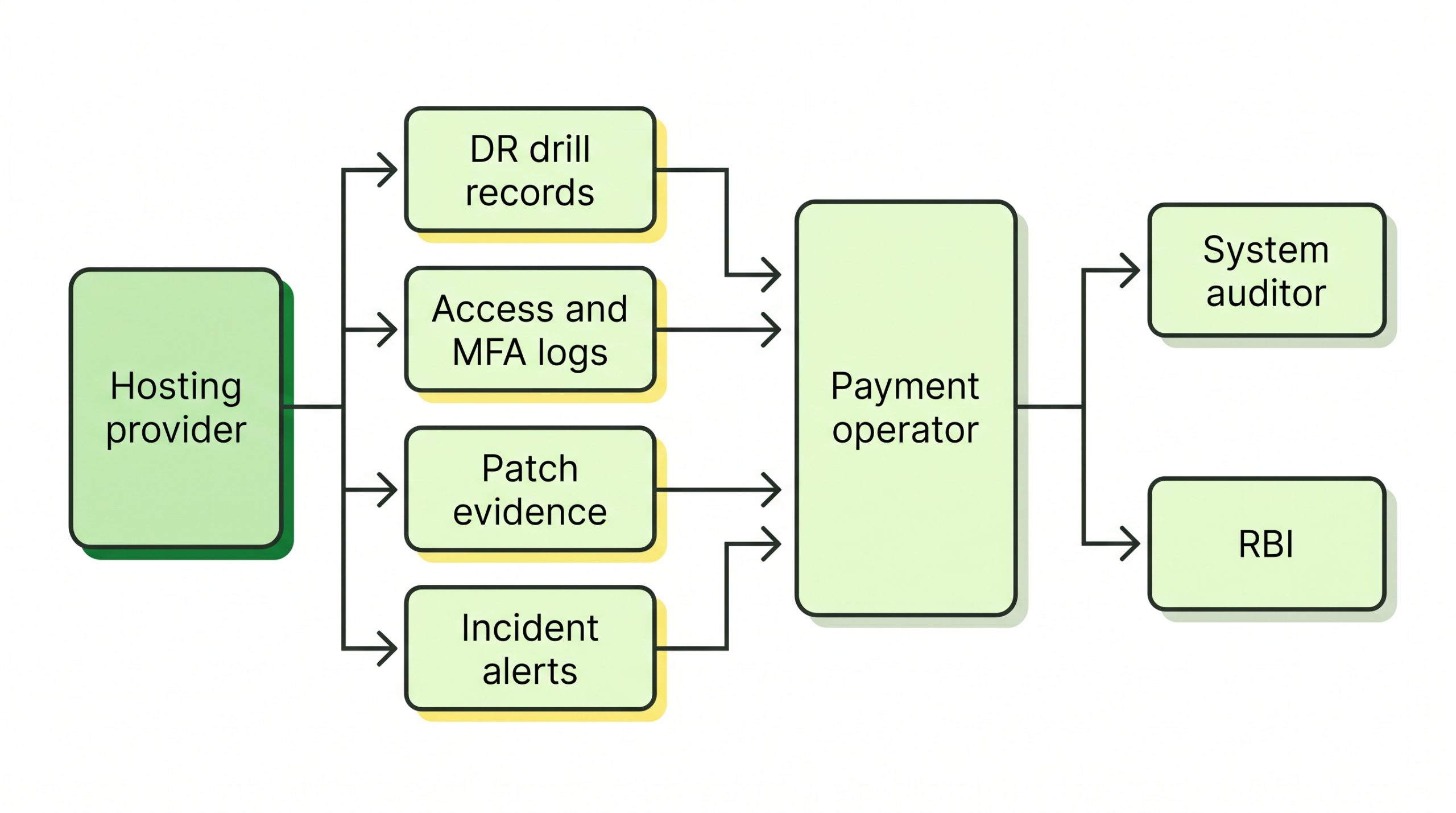
Figure 1. The hosting provider produces DR drill records, access and MFA logs, patch evidence and incident alerts; the payment operator presents them to the system auditor and RBI.
Backup, DR, access and log evidence to collect
The directions fix a frequency or period for backup tests, DR drills, audit logs and incident reporting. The access and patch controls below sit alongside them in the evidence file.
Backup restore tests every six months
Paragraph 20(f) asks PSOs to test backed-up data at least half-yearly. The test must show recovery without loss of transactions or audit trails. Does the provider supply a dated restore report that shows exactly that? Our immutable backup restore drill guide sets out how to time and log such a restore.
DR site, drills and near-zero RPO
Paragraph 23 sets three hosting tests. The DR facility sits in a different seismic zone from the primary data centre. DR drills run half-yearly or more often, and any divergence from the recovery time objective (RTO) or recovery point objective (RPO) is analysed and fixed urgently. The PSO also strives for near-zero RPO and keeps a defined method to reconcile data after resuming from DR.
RBI does not set a numeric RTO here. Our SEBI CSCRF disaster recovery RTO and RPO checklist covers a separate framework. For a PSO, does the drill report show the RTO and RPO the PSO set, the values achieved and the fixes raised?
Privileged access and MFA
Paragraph 15 requires MFA on privileged accounts, tight monitoring and a rotation policy. It also asks for sessions that lock after inactivity and physical safeguards that are tested periodically. Does the privileged account list include the provider’s own administrator, console and out-of-band access to the PSO’s servers?
Audit logs: five years for RBI, 180 days for CERT-In
Paragraph 27(e) asks for audit logs that identify the user, the action and its parameters. RBI requires those logs to be kept for at least five years, with controlled access. Separately, the CERT-In directions of 2022 require entities to keep ICT system logs for a rolling 180 days within Indian jurisdiction. The same CERT-In directions ask for clocks synchronised to NIC or NPL time servers, or sources traceable to them.
Does the provider’s retention setting meet each period for the logs it covers? Our guide to CERT-In 180 days log retention for servers covers the central log server and time sync.
Patch proof
Paragraph 21 asks for a documented patch process. Security patches go in within an appropriate time from release, and critical patches for known attacks go in immediately. Patches and changes reach production only after testing in another environment. Patch management is also one of the items the annual system audit examines.
EVIDENCE TO REQUEST
|
How does the six-hour incident clock reach a hosting provider?
RBI counts six hours from detection, and CERT-In counts six hours from noticing an incident. Paragraph 22(d) lists cyber-attacks, outages of critical systems or infrastructure, internal fraud and settlement delays as examples. So the open question for a hosted PSO sits in the contract. Does the contract say how soon the provider must alert the PSO after it detects a hardware failure, an intrusion or a power event?
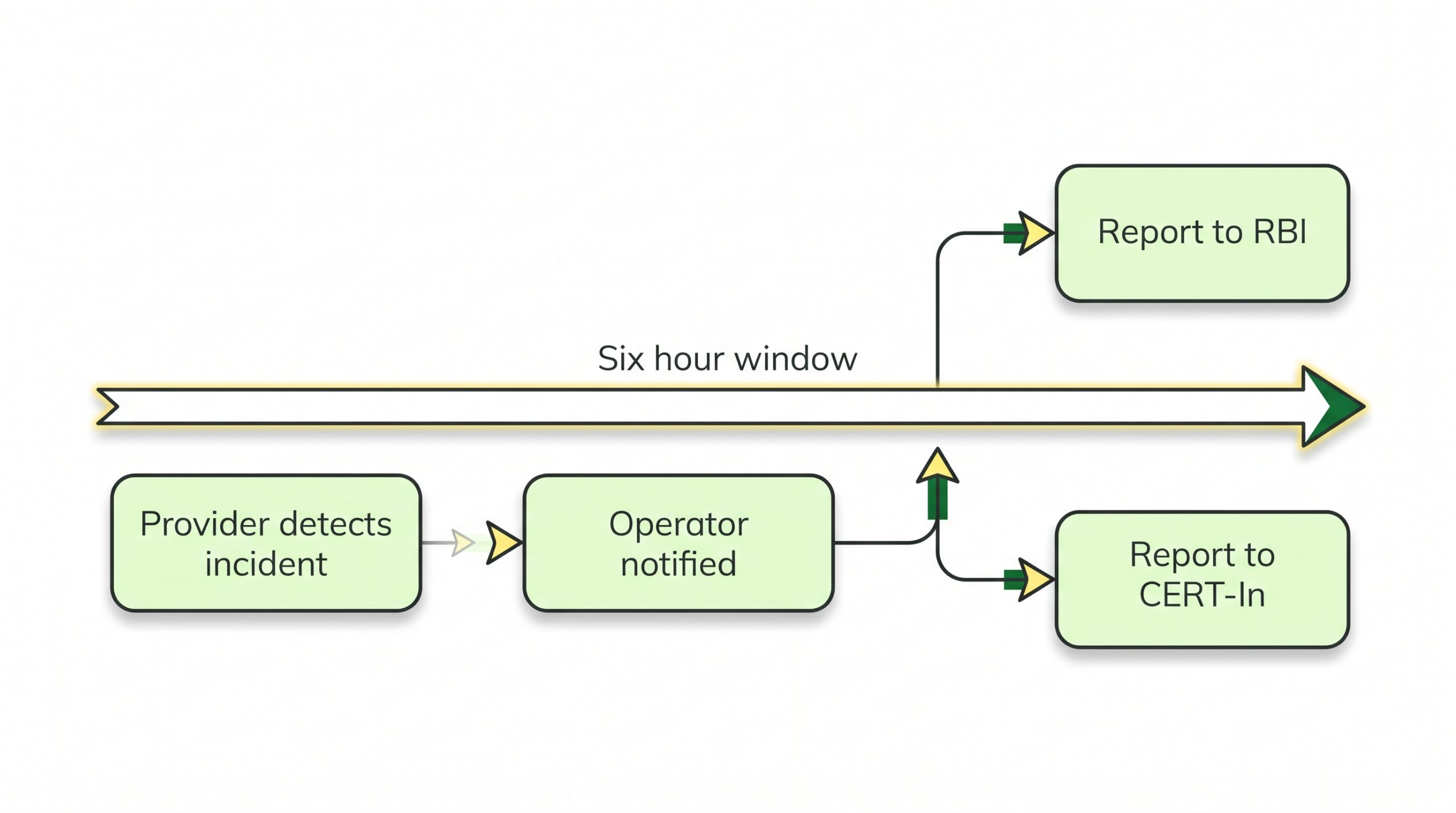
Figure 2. RBI’s six hour window runs from detection; the contract can set how soon the provider alerts the operator before the operator reports to RBI and CERT-In.
The 2021 outsourcing framework for PSOs supports this flow-down. It asks the PSO to require the service provider to disclose security breaches. It also asks the PSO to notify RBI immediately of any breach of security or leakage of customer information. The annual audit scope repeats the point: vendor agreements should carry mandatory disclosure of any security incident specific to the entity’s systems.
The questions to settle in writing are short:
- Which provider events count as an incident for the PSO, and does the list match RBI’s Annex 2 types?
- How many minutes after detection does the provider alert the PSO, and through which channel?
- Who at the PSO receives the alert at night, and who is the backup contact?
- Which logs and timestamps does the provider hand over for the RBI and CERT-In formats?
Contract clauses and the annual system audit
The RBI outsourcing framework of 3 August 2021 lists the clauses an outsourcing agreement should carry. Paragraph 19 of the 2026 directions points PSOs back to it for vendor risk. For a hosting contract, the relevant clauses are these:
- PSO access to all books, records and information relevant to the outsourced activity.
- The PSO’s right to audit the provider and to obtain copies of audit reports.
- RBI’s right to access records and to inspect the provider.
- Prior PSO consent before the provider uses sub-contractors.
- Contingency plans for business continuity.
- Preservation of documents and data after termination.
Data location is a separate clause. RBI’s 2018 circular requires the entire data relating to payment systems to be stored in a system only in India. The framework also requires the provider to isolate each PSO’s customer information, documents and records. The boundary between the facility, infrastructure and application layers is mapped in our data centre managed services checklist, which helps decide who signs each clause.
How the annual system audit uses hosting evidence
Paragraph 36 asks for a System Audit Report (SAR) every year. A CERT-In empanelled auditor, an ISACA Certified Information Systems Auditor (CISA) or an ICAI Diploma in Information System Audit (DISA) holder conducts it. PSOs on an April to March year submit it by 1 June; calendar-year PSOs submit by 1 March. Paragraph 37 bars a firm that served the PSO in the last two financial years from auditing it.
The auditor tests each control for design and for operating effectiveness. MediaNama counts 20 areas in the scope. Several of them depend on hosting records:
- Physical and environmental security.
- Business continuity management, including DR capability and regular BCP drills.
- Patch management and change management.
- Log management, from generation to disposal.
- Vendor risk, including regulator right of audit or inspection and mandatory incident disclosure in the service level agreement.
Does the evidence file hold dated records that let the auditor test operating effectiveness across the year?
Which operator needs which records
- Payment aggregators that store card data also follow PCI-DSS and need PCI-DSS certification under paragraph 20(e). Does the hosting file include the provider’s evidence for the card data environment?
- A WLAO must ensure through contracts that its third-party ATM switch provider follows RBI’s security rules. MediaNama reports that the switch provider must block unapproved software, cut off remote access to the network hosting the ATM switch and run a SOC.
- Medium PPI issuers comply now. Small PPI issuers have until 1 April 2028 to build the same file.
- For a card network on cloud infrastructure, paragraph 26 adds a cloud operation policy and the provider’s annual independent audit.
| Criterion | Why it matters | What to verify |
|---|---|---|
| Backup restore tests | RBI asks for tests at least half-yearly | Two dated restore reports a year with reconciliation |
| DR site and drills | DR in a different seismic zone, drills half-yearly or more often | Site location in writing and drill reports with RTO and RPO |
| Privileged access | MFA, monitoring and rotation for privileged accounts | Named provider admin list with MFA and rotation dates |
| Audit logs | Five years under RBI, 180 days in India under CERT-In | Retention settings, archive proof and NTP sources |
| Incident alerts | Six hours to RBI and CERT-In from detection | Alert time, channel and contacts written into the contract |
| Contract clauses | Outsourcing framework and data stored only in India | Audit and inspection rights, sub-contractor consent, data location |
FAQs
Do the RBI cyber resilience directions apply to a hosting provider directly?
The directions are addressed to authorised non-bank PSOs. Paragraph 5 asks PSOs to ensure adherence by third-party service providers and vendors, subject to mutual agreement. CERT-In’s 2022 directions are different: they name data centres themselves, alongside service providers and body corporates.
How long must a payment aggregator keep audit logs?
RBI asks for audit logs to be preserved for at least five years. CERT-In separately asks for ICT system logs for a rolling 180 days, kept within Indian jurisdiction. Does the retention setting cover five years for audit logs and a rolling 180 days for ICT system logs, held in India?
Who can conduct the system audit for a payment system operator?
A CERT-In empanelled auditor, a CISA registered with ISACA or a DISA holder from ICAI can conduct it. The firm and its sister concerns must not have provided any service to the PSO in the last two financial years. So a firm that hosted or advised the PSO within that period cannot be its auditor.
When do small PPI issuers have to comply with the RBI cyber directions?
Small non-bank PSOs, which MediaNama lists as small prepaid wallet issuers and instant money transfer operators, comply from 1 April 2028. Large and medium PSOs comply from the day RBI placed the directions on its website.
Building the evidence file before the audit
The 2026 directions fix a frequency or period for four hosting controls: half-yearly restore tests, half-yearly DR drills, five-year audit logs and a six-hour reporting window. Does the PSO run its own facility and servers, or does a provider operate the infrastructure that holds its payment systems, and who then produces each record in the table?
Hosting evidence covers only part of the directions. Board governance, the Cyber Crisis Management Plan and the digital payment controls, such as device binding and the 12-hour cooling period, sit with the PSO’s own teams and applications. Does the provider’s certificate state which controls it covers and which stay with the PSO’s application? Banks fall outside this text, because the directions address authorised non-bank PSOs.
Two questions decide where to start. Can the provider produce last half-year’s restore and DR drill reports today? Is the six-hour alert path written into the contract, with names and minutes?
| NEXT STEP Compare the evidence list above with the scope of RackBank managed services for backup, monitoring and compliance evidence, and mark which records each side will produce. |