TL;DR
• Edge datacenters are becoming essential infrastructure for real-time computing, AI workloads, and latency-sensitive applications across India.
• Low-latency datacenter architecture reduces response times from milliseconds to microseconds, enabling next-gen use cases like autonomous systems, AI inference, and immersive applications.
• Distributed edge cloud infrastructure will complement hyperscale data centers, not replace them. Hybrid architectures will dominate.
• India’s digital economy, 5G rollout, and AI adoption are accelerating demand for edge computing India deployments.
• Organizations investing early in real-time edge infrastructure gain a strategic advantage in performance, data locality, and scalability.
Over the past decade, cloud infrastructure has evolved from centralized hyperscale facilities to highly distributed computing models. Today, the next phase of this evolution is clearly visible: the rise of the edge datacenter.
As CTOs are responsible for building infrastructure that supports AI workloads, real-time services, and digital platforms, one pattern is becoming impossible to ignore. Applications increasingly demand real-time computing infrastructure and ultra-low latency processing. Traditional centralized architectures struggle to meet those expectations.
In India especially, the convergence of 5G networks, AI adoption, IoT devices, and digital platforms is driving a fundamental shift toward low-latency datacenter architectures located closer to users and devices.
In simple terms, the future of digital infrastructure is not just bigger datacenters. It is a smarter, distributed edge cloud datacenter solution.
Why Edge Datacenters Are Becoming Critical
The Latency Problem in Traditional Infrastructure
Traditional cloud models rely on centralized hyperscale facilities that may be hundreds or thousands of kilometers away from the end user. For many workloads, this model works well.
But the moment applications require real-time responsiveness, latency becomes a serious bottleneck.
Consider a few modern workloads:
• Autonomous vehicles processing sensor data
• AI-powered video analytics
• AR/VR immersive experiences
• Industrial robotics and smart manufacturing
• Real-time financial trading systems
In these environments, even a 20–30 millisecond delay can degrade system performance.
This is where low-latency edge computing changes the architecture. By deploying micro datacenters and edge server deployment nodes closer to users, data can be processed locally instead of traveling to distant cloud regions.
This dramatically improves response times.
Edge Cloud Infrastructure: A Distributed Computing Model
From Centralized Clouds to Distributed Computing
Edge datacenters are part of a broader distributed computing strategy where compute resources exist across multiple layers:
- Core hyperscale datacenters for large-scale workloads
- Regional datacenters for cloud services and storage
- Edge cloud infrastructure nodes for real-time data processing
This layered architecture enables latency optimization and localized data processing.
Instead of sending all data to a central cloud region, edge infrastructure performs initial computation and filtering locally, sending only relevant data to the core cloud.
This approach significantly improves:
• Application performance
• Network efficiency
• Data processing speed
• Infrastructure scalability
For many organizations deploying edge datacenters for AI, this model is becoming the default architecture.
Real-Time Data Processing at the Edge
Edge AI Infrastructure and Intelligent Systems
The most powerful use case for edge datacenters lies in AI inference and real-time analytics.
Training AI models still happens in large GPU clusters located in core datacenters. But inference workloads increasingly run at the edge.
Examples include:
• Smart cities running video analytics at intersections
• Manufacturing plants using AI for defect detection
• Telecom networks optimizing traffic in real time
• Retail stores using computer vision for operations
These systems require real-time edge infrastructure capable of processing data within milliseconds.
By 2027, over 50% of enterprise-managed data will be processed outside traditional datacenters or cloud environments. This shift directly drives demand for edge data processing and localized compute infrastructure.
Edge Computing India: Market Growth and Infrastructure Demand
India’s edge computing market is accelerating rapidly.
Several factors are contributing to this growth:
• Nationwide 5G network expansion
• Explosion of IoT devices and sensors
• Growth of AI-driven applications
• Demand for data localization and sovereignty
Industry analysts estimate that India’s edge computing market could grow at nearly 30% CAGR over the next decade, fueled by 5G rollout, AI adoption, and the rapid expansion of IoT ecosystems.
As a result, we are seeing increased demand for:
• Micro datacenters deployed in tier-2 and tier-3 cities
• Edge networking solutions integrated with telecom infrastructure
• Low-latency datacenter clusters near major digital hubs
For enterprises searching for edge datacenters, the expectation is simple: infrastructure must exist closer to users and applications.
Infrastructure Strategy: Edge Datacenters vs Traditional Datacenters
Edge infrastructure should not be seen as a replacement for hyperscale data centers.
Instead, it acts as a strategic extension of centralized cloud architecture.
Hyperscale facilities remain essential for:
• AI model training
• Large-scale data storage
• Enterprise cloud workloads
• High-performance computing
Edge datacenters complement them by enabling:
• Real-time data processing at edge locations
• Latency-sensitive application deployment
• Localized compute capacity
The organizations that succeed will design infrastructure that integrates both layers seamlessly.
Growth of Edge Computing Infrastructure
Global Edge Computing Infrastructure Growth
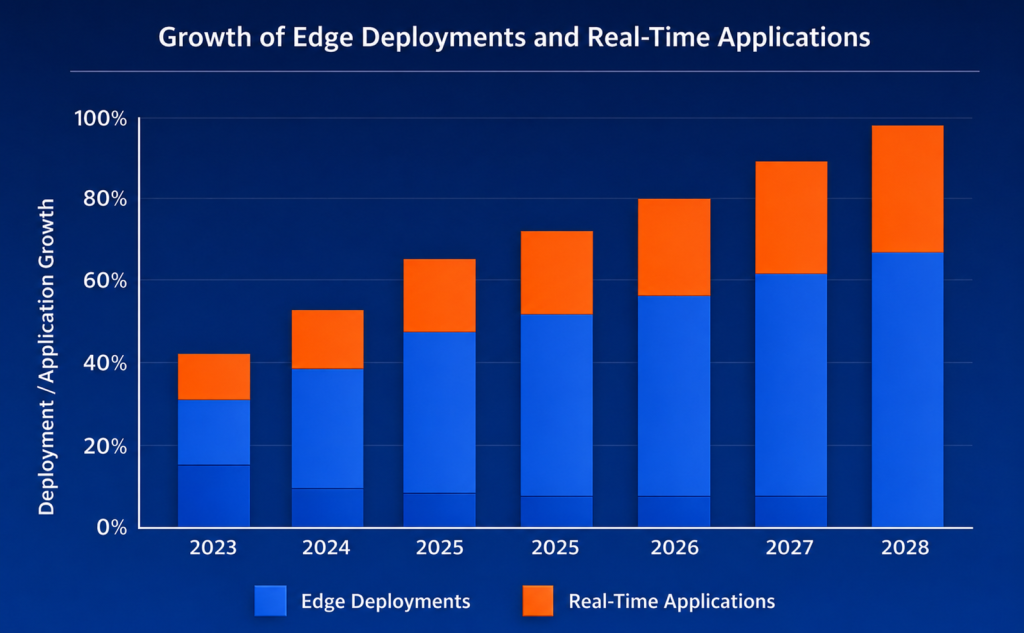
The trend is clear: real-time applications and edge infrastructure are scaling together.
Conclusion
The edge datacenter is rapidly becoming a foundational layer of modern digital infrastructure.
As AI systems, real-time applications, and connected devices expand across industries, the demand for low-latency edge computing and distributed infrastructure will only intensify.
The organizations that succeed will not treat edge infrastructure as an experiment. They will design real-time computing infrastructure that integrates hyperscale cloud, regional datacenters, and edge nodes into a unified architecture.
From my perspective as a CTO, the trajectory is clear. The next generation of digital platforms will not run solely in centralized clouds. They will operate on distributed edge cloud datacenter solutions that bring compute power closer to where data is created and decisions must be made in real time.
That is the true promise of edge computing India and the future of edge datacenters for AI.
The future won’t wait for centralized infrastructure.
Start building your edge-ready architecture today and stay ahead in a real-time world.
FAQs
What are the benefits of edge datacenters for real-time applications?
Edge datacenters reduce latency by processing data closer to the user or device. This improves response time, application performance, and reliability for workloads like AI inference, robotics, and real-time analytics.
How does edge computing reduce latency?
Edge computing reduces latency by minimizing the physical distance data must travel. Instead of sending data to distant cloud regions, edge infrastructure processes information locally at edge server deployment nodes.
What is low-latency infrastructure for AI and ML?
Low-latency infrastructure refers to distributed edge AI infrastructure that enables real-time AI inference close to where data is generated. This is critical for applications like computer vision, robotics, and autonomous systems.
Edge datacenters vs traditional datacenters: what is the difference?
Traditional datacenters are centralized facilities designed for large-scale compute and storage. Edge datacenters are smaller distributed nodes located closer to users, optimized for low latency and real-time workloads.
How are micro datacenters used for IoT applications?
Micro datacenters process IoT sensor data locally, enabling real-time data processing at edge locations. This reduces network congestion and allows faster responses in industries such as manufacturing, transportation, and smart cities.
Are edge datacenters cost-effective in India?
Yes. With increasing demand for cost-effective edge datacenter solutions in India, organizations are deploying distributed edge infrastructure to reduce bandwidth costs and improve application performance.