

|
Moving from SAP ERP Central Component (ECC) to SAP S/4HANA is not only an application migration. It also changes the infrastructure that supports the target system, including database capacity, temporary project environments, network connectivity and the production cutover plan.
For IT heads and SAP Basis teams, the challenge is to size the target SAP HANA environment correctly while keeping the existing ECC system available for testing and migration. This guide covers the infrastructure requirements, downtime planning, SAP sizing tools and hosting options to evaluate before the conversion begins.
For the broader pre-go-live assessment, see our ERP Infrastructure Readiness Checklist.
What the December 2027 Date Changes for Your Infrastructure Timeline
In February 2020 SAP committed to mainstream maintenance for core SAP Business Suite 7 applications, including SAP ERP 6.0, until the end of 2027, followed by optional extended maintenance until the end of 2030. Extended maintenance carries a premium of two percentage points on the existing maintenance basis. Customers who neither convert nor opt for it by the end of 2027 move automatically to customer-specific maintenance, and the same announcement set the S/4HANA maintenance commitment to the end of 2040.
In October 2026 SAP’s CTO confirmed the dates have not changed and set out what ends with them. For Business Suite 7 on a third-party database, SAP states that system conversion tooling to S/4HANA is available only until the end of 2030; after that, only greenfield implementations are supported. Under customer-specific maintenance from 2031, SAP will not provide kernel patches, including kernel security patches, for third-party database environments.
If the goal is S/4HANA in production before extended maintenance fees begin in January 2028, one planning question follows: when must the sandbox, development and quality systems be ready, and is that date in the project plan? Enterprises expecting to overrun should note that SAP’s time-bound transition option for 2031 to 2033, aimed at its largest customers, requires the system to be on SAP ERP, private edition on SAP HANA before 31 December 2030.
Which Infrastructure Environments Are Needed During Migration?
An ECC to S/4HANA project may require more infrastructure during migration than the final production environment alone. The exact landscape depends on the conversion method, project scope and number of concurrent test runs.
Before finalising capacity, map the environments that will run simultaneously and identify which can be reused, resized or decommissioned after the migration.
| Environment or requirement | Infrastructure planning consideration |
|---|---|
| Sandbox and conversion rehearsal | Provide a representative system copy for initial conversion testing and identifying issues. |
| Development and quality assurance | Confirm which systems need upgrades, conversion testing and integration validation before production cutover. |
| Target SAP HANA environment | Size compute, memory and storage for the intended production workload and supported configuration. |
| Source ECC environment | Plan for continued source-system operation during the relevant conversion phases and confirm the supported recovery procedure. |
| Temporary migration capacity | Estimate the compute, storage and network resources needed during data migration and repeated test runs. |
| Cross-site connectivity | Validate bandwidth, latency and transfer duration if the source and target environments are in different data centres. |
These requirements should be confirmed against the selected SAP conversion procedure and the project’s actual system landscape. Do not assume that every environment needs a separate new physical server; the supported deployment design and concurrent resource demand determine the final requirement.
How Long Will Production Be Down During the Conversion?
SAP provides a Downtime Prediction Tool to estimate the technical downtime of an SAP S/4HANA conversion using statistics from comparable conversion projects. The estimate can support initial planning, but it is not a guaranteed cutover duration. Validate the expected downtime through rehearsals on a representative copy of the production system. Refer to SAP Note 3558521 and confirm the applicable guidance for your conversion scenario.
In a standard DMO run, SUM builds a shadow repository on the target HANA database while the system is still up. When downtime starts, the database connection switches to the target and application data is migrated and converted.
According to the SAP Support Portal, the downtime-optimized conversion reduces technical downtime by running data conversion and migration in uptime, and it is available for source systems on SAP HANA or on another database. The sequence runs like this:
- Uptime: initial migration of the tables affected by the new data model to SAP HANA, with database triggers recording user changes.
- Uptime: data conversion of the migrated data to the S/4HANA model.
- Delta replay via triggers as users continue to change data.
- Downtime: final delta migration and conversion, plus the remaining tables.
- System back in uptime on S/4HANA.
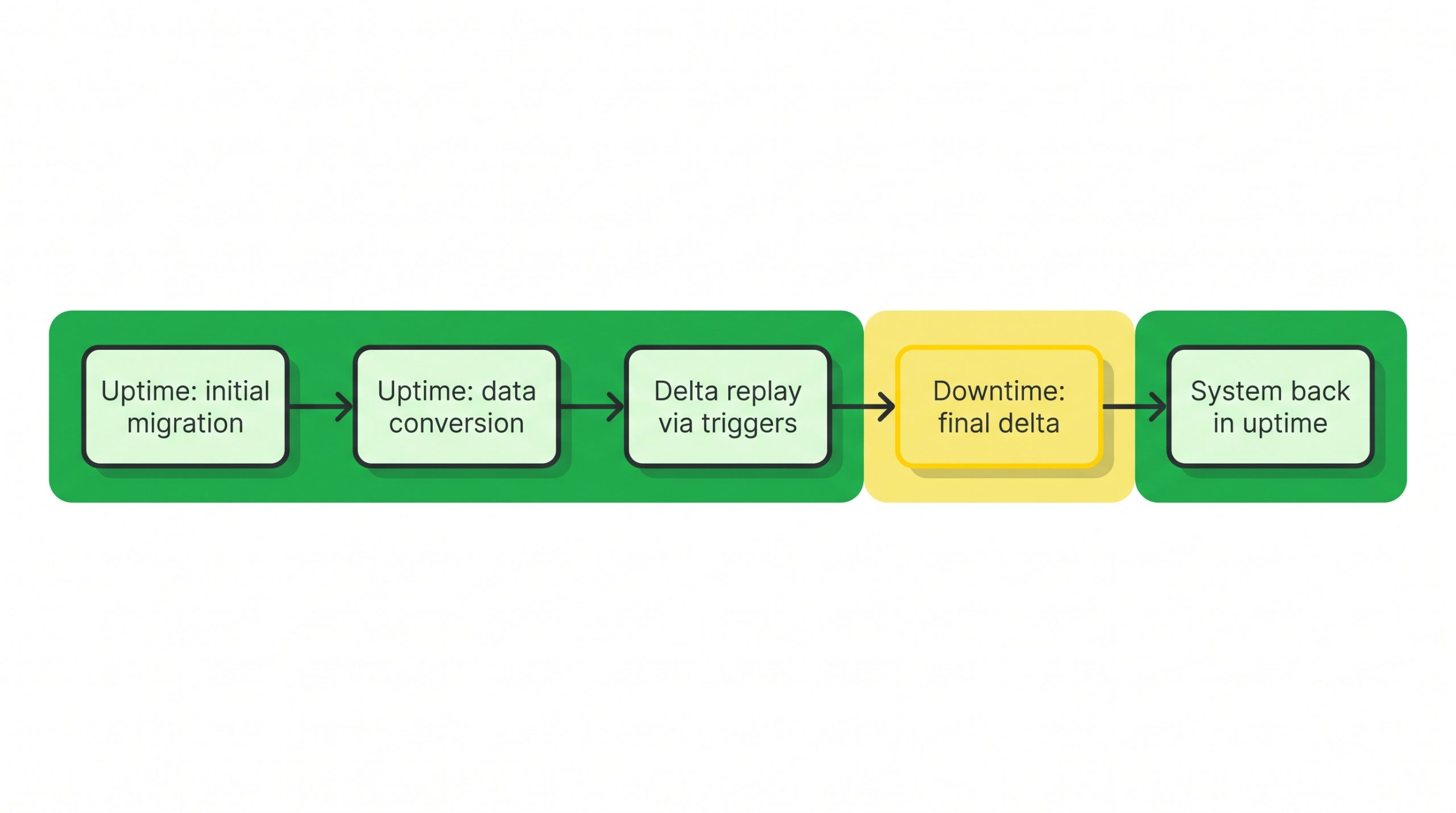
Figure 1. Timeline of a downtime-optimized conversion, with initial migration, data conversion and delta replay in the uptime phase and the final delta in the downtime phase.
That shorter window has consequences of its own:
- Source system load. SAP says mass load activities on production must be avoided during the replication phase.
- Change freeze. SAP lists restrictions on production before downtime, including a customizing freeze and a lock on development activities.
- Skills. SAP states the approach needs an expert who has completed its specific training, and that project planning is more complex than for a standard conversion.
- Network between hosts. If the target HANA server sits in a different data centre from ECC, the move variant matters. SAP’s training notes that DMOVE2S4, the DMO variant that moves the system to S/4HANA in another data centre, requires a sufficient network connection between source and target data centre, with DMO with system move as the alternative when that cannot be met.
Sizing the HANA Server With SAP’s Own Tools
SAP’s sizing tools include the report /SDF/HDB_SIZING, which SAP updates regularly; its HANA administration training says to check SAP Note 1872170 for the current version of /SDF/HDB_SIZING before running it.
SAP describes Quick Sizer as a way to translate business requirements into technical requirements, using user-based and throughput-based sizing models.
| Sizing input | What SAP states | What to verify |
|---|---|---|
| /SDF/HDB_SIZING | Regularly updated; check SAP Note 1872170 for the current version | Does this report apply to our conversion route? |
| SAP Quick Sizer | User-based and throughput-based sizing models | Which sizing model fits our business volumes? |
| Hardware rule | Certified server and storage from the SAP HANA Hardware Directory | Exact server and storage models in the directory |
Sources: SAP Learning on SAP HANA sizing; SAP Quick Sizer page; SAP Help Portal on tailored data center integration.
Turning a sizing figure into a growth plan without buying for a distant peak is covered in our database server capacity planning guide.
Whichever route is taken, the platform has to sit inside SAP’s support boundary. SAP’s help page on tailored data center integration states that the server must be certified and listed in the hardware directory, and all storage devices must have passed SAP HANA hardware certification. Why HANA’s CPU, memory and storage profile differs from a conventional database server is explained in our post on why SAP HANA needs high-performance servers.
Where to Host SAP ECC to S/4HANA Migration Infrastructure in India
The hosting choice comes down to three questions: who owns and refreshes the certified hardware, how close the new HANA systems sit to the ECC source during migration, and where the data must reside.
| Hosting option | Fits | Watch for |
|---|---|---|
| Refresh the on-premise server room | Enterprises with an existing certified estate and in-house Basis and facility teams | Is there power, cooling and rack space for ECC and the new HANA systems at the same time? |
| Colocation of owned certified hardware | Teams that want to own HANA servers but not run a facility | Network path back to ECC if ECC stays on-premise during migration |
| Dedicated hosted servers on certified hardware | Enterprises that want production-class HANA without a capital purchase | Exact server model checked against the SAP HANA Hardware Directory |
| SAP ERP, private edition on SAP HANA | Largest customers needing SAP’s 2031 to 2033 transition option | Transition option requires SAP ERP, private edition on SAP HANA before 31 Dec 2030 |
Sources: SAP Help Portal on tailored data center integration; SAP News Center on the 2030 changes; SAP Learning on DMOVE2S4.
Each Watch for item is a point to verify with the provider or facility team before choosing an option.
Three scenarios show how the choice plays out:
- Brownfield from a third-party database, ECC on-premise. SAP states conversion tooling from a third-party database is available only until the end of 2030. Can the link between ECC and the target datacentre support DMOVE2S4, or is DMO with system move the route?
- Greenfield implementation. Where do users in plants and branches connect from, and what latency to the new landscape will they accept?
- Banking, financial services and insurance (BFSI) or government entity with an internal data residency policy. Colocation or dedicated servers in Indian facilities keep the ERP data in India.
For the server-level checks on a hosted ERP platform, from ECC memory to support terms, see our guide to dedicated servers for ERP.
Some questions sit outside the hosting decision: who on the SAP project team owns custom code remediation, data quality, business partner conversion and change management, and has every add-on been checked against the target release?
| WHAT TO VERIFY Server and storage models listed in the SAP HANA Hardware Directory for your target release. Memory for production plus any production copies that run at the same time. Measured bandwidth and latency between the ECC host and the target data centre. Whether the ECC database host can stay in service for the full SUM procedure. Where backups and replicas are stored, and in which Indian facility. |
The summary below pulls the whole plan into one view.
| Criterion | Why it matters | What to verify |
|---|---|---|
| Maintenance date | Extended maintenance premium applies from 2028 | Target go-live date and the fallback plan if it slips |
| Source database | Third-party database conversion tooling ends with 2030 | Current database type and the conversion route it allows |
| Landscape count | Several runs on copies of production; with DMO the source database stays as fallback | Number of concurrent HANA systems by month |
| HANA sizing | What size of certified server does production need? | /SDF/HDB_SIZING or Quick Sizer output |
| Downtime | Which downtime can the business accept, and which procedure meets it? | Downtime measured on a production copy rehearsal |
| Network | Move scenarios depend on the link between sites | Bandwidth and latency between ECC and target hosts |
| Certification | Defines the SAP support boundary | Server and storage entries in the SAP HANA Hardware Directory |
FAQs
Can we keep running SAP ECC after December 2027?
Yes, either through optional extended maintenance to the end of 2030 at a premium, or by moving to customer-specific maintenance, which SAP describes as problem solving for known issues. For systems on a third-party database, SAP has said customer-specific maintenance from 2031 will not include kernel patches for those environments. For third-party database or Java environments, SAP does not regard customer-specific maintenance as a sustainable long-term model.
Can the existing ECC database server be reused for HANA?
Only if that exact server model and configuration appear in the SAP HANA Hardware Directory. In a DMO conversion, the source database stays in service as the fallback while the SUM procedure runs. A point to settle in the plan: which host will the HANA target run on while the ECC host is still serving as the fallback?
Does brownfield or greenfield need less infrastructure?
For brownfield with the downtime-optimized approach, SAP states that several runs on copies of production are needed. For either approach, the points to confirm are which systems run at the same time and which SAP sizing tool applies.
Planning the Move Before the End of 2027
Four questions for the infrastructure plan: how many HANA systems will run at once, what SAP’s own sizing tools return for production, how long downtime runs on a production copy, and whether the hosting can keep the ECC database host in service for the full SUM procedure.
| NEXT STEP For teams planning target and test landscapes now, our SAP Solutions page describes SAP-certified hardware on dedicated servers for SAP workloads. |
